
Trooper Michael Hayen
North Dakota Highway Patrol Trooper Michael Hayen's feature 'Under the Trooper's Hat' provides information for safe traveling on ND's roadways as well as the duties and responsibilities of NDHP troopers. Articles appear in local newspapers as well as on this site. Click on the titles below to read the articles.
TRIANGLE PLACEMENT- NEW!
When a commercial vehicle becomes disabled along the roadway, it creates an unexpected hazard for other drivers. At highway speeds, even a few seconds of warning can make the difference between a safe slowdown and a serious crash. Federal safety regulations require commercial motor vehicles to carry and properly place emergency warning triangles when stopped on the traveled portion of a highway or the shoulder. The placement of these triangles is essential for safety.
Any time a commercial motor vehicle is stopped for reasons other than a necessary traffic stop, the driver must immediately activate the vehicle’s hazard warning flashers. The flashers should remain activated while the emergency triangles are being placed and again when they are being picked up before the vehicle moves. While hazard lights help alert approaching drivers, they are not a substitute for emergency triangles, so both hazard lights and triangles must be used together.
On a two-lane, undivided highway such as ND Highway 3, ND Highway 83, ND Highway 13, , traffic can approach from both directions, so warning devices must be placed to alert drivers coming from both directions. Within ten minutes of stopping, three emergency triangles must be set out.
- One triangle should be placed on the traffic side of the vehicle within ten feet of the rear of the truck.
- A second triangle must be placed approximately one hundred feet behind the vehicle in the center of the lane or shoulder being occupied, in the direction of approaching traffic.
- The third triangle must be placed about one hundred feet in front of the vehicle, also in the center of the lane or shoulder in order to warn traffic approaching from the opposite direction.

On divided highways or one-way roads such as I-94 and I-29, triangle placement is different because traffic only approaches from one direction. On these roads, all three warning devices are placed behind the vehicle.
- One triangle must be placed within ten feet of the rear of the truck on the traffic side.
- A second triangle is placed approximately one hundred feet behind the vehicle in the center of the lane or shoulder being occupied.
- The third is placed about two hundred feet behind the vehicle on the shoulder being used.
When a commercial vehicle becomes disabled along the roadway, it creates an unexpected hazard for other drivers. At highway speeds, even a few seconds of warning can make the difference between a safe slowdown and a serious crash. Federal safety regulations require commercial motor vehicles to carry and properly place emergency warning triangles when stopped on the traveled portion of a highway or the shoulder. The placement of these triangles is essential for safety.
Any time a commercial motor vehicle is stopped for reasons other than a necessary traffic stop, the driver must immediately activate the vehicle’s hazard warning flashers. The flashers should remain activated while the emergency triangles are being placed and again when they are being picked up before the vehicle moves. While hazard lights help alert approaching drivers, they are not a substitute for emergency triangles, so both hazard lights and triangles must be used together.
On a two-lane, undivided highway such as ND Highway 3, ND Highway 83, ND Highway 13, , traffic can approach from both directions, so warning devices must be placed to alert drivers coming from both directions. Within ten minutes of stopping, three emergency triangles must be set out.
- One triangle should be placed on the traffic side of the vehicle within ten feet of the rear of the truck.
- A second triangle must be placed approximately one hundred feet behind the vehicle in the center of the lane or shoulder being occupied, in the direction of approaching traffic.
- The third triangle must be placed about one hundred feet in front of the vehicle, also in the center of the lane or shoulder in order to warn traffic approaching from the opposite direction.
On divided highways or one-way roads such as I-94 and I-29, triangle placement is different because traffic only approaches from one direction. On these roads, all three warning devices are placed behind the vehicle.
- One triangle must be placed within ten feet of the rear of the truck on the traffic side.
- A second triangle is placed approximately one hundred feet behind the vehicle in the center of the lane or shoulder being occupied.
- The third is placed about two hundred feet behind the vehicle on the shoulder being used.

Emergency triangles are a simple but critical safety measure. Proper placement helps prevent secondary crashes; protects the driver of the stopped vehicle; and gives approaching motorists time to slow down and move over safely. Taking a few minutes to place them correctly is not just about following the rules — it’s about keeping everyone on the road safe.
Farm Truck Reminder: Yes, this applies to you
Many drivers may assume emergency triangle rules only apply to semi-trucks and long-haul carriers. That is not always the case. Some federal motor carrier safety regulations apply to covered farm vehicles, which include farm trucks used to haul grain, livestock, seed, fertilizer, or equipment when specific weight and use requirements are met.
If a farm truck is considered a covered farm vehicle and is operated on a public roadway, the driver is required to carry emergency warning devices and to place them properly if the vehicle becomes disabled on the roadway or shoulder.
Emergency triangles are a simple but critical safety measure. Proper placement helps prevent secondary crashes; protects the driver of the stopped vehicle; and gives approaching motorists time to slow down and move over safely. Taking a few minutes to place them correctly is not just about following the rules — it’s about keeping everyone on the road safe.
Farm Truck Reminder: Yes, this applies to you
Many drivers may assume emergency triangle rules only apply to semi-trucks and long-haul carriers. That is not always the case. Some federal motor carrier safety regulations apply to covered farm vehicles, which include farm trucks used to haul grain, livestock, seed, fertilizer, or equipment when specific weight and use requirements are met.
If a farm truck is considered a covered farm vehicle and is operated on a public roadway, the driver is required to carry emergency warning devices and to place them properly if the vehicle becomes disabled on the roadway or shoulder.
SIDE OF THE ROAD
If you’ve ever passed a state trooper parked in the median, on the shoulder, or along an approach and thought, “What are they up to?” — you’re not alone. Is the trooper running radar? Waiting for a call? Taking a break? The honest answer is yes… sometimes. And often, it’s much more than that.
For most troopers, the patrol car is not just a vehicle; it is their office. Unlike most professions, troopers do not have a desk to work from. Reports, emails, phone calls, case documentation, crash narratives, and court paperwork are usually completed from inside the squad car. When you see a trooper parked along the roadway, they may be writing a detailed crash report; documenting an arrest; completing a citation; responding to emails; or entering the information required by law before moving on to the next call.
Sometimes, troopers are participating in high-visibility patrols. Simply being seen matters. Numerous traffic safety studies have shown that the visible presence of law enforcement on the roadside reduces speeding, aggressive driving, and crashes. When drivers see a marked patrol vehicle, speeds drop, phones disappear, seatbelts click, and drivers’ attention levels rise almost instantly. A trooper sitting stationary can often prevent violations and collisions without ever activating their emergency lights.
Troopers may also be monitoring traffic for something very specific such as watching for a stolen vehicle; a wanted person; or a vehicle connected to a recent crime. Modern law enforcement relies on awareness and observation, and positioning a patrol vehicle in a strategic location can be critical to identifying a suspect vehicle before it disappears.
Another important — and often overlooked — reason troopers may pull over is for safety and mental well-being. Law enforcement officers routinely deal with high-stress and sometimes traumatic situations: serious crashes, injuries, fatalities, domestic disputes, and crimes involving individuals at their worst moments. Before responding to the next call, a trooper may need a few moments to decompress, regain focus, or mentally process what they have just experienced. Taking a brief pause can be essential to ensuring they are mentally prepared to safely and professionally handle whatever comes next.
Of course, troopers may also be assisting a stranded motorist, coordinating with other emergency responders, or positioning themselves to respond quickly to calls for service. Every stop on the roadside has a purpose, even if that purpose isn’t immediately obvious to passing motorists.
So the next time you see a state trooper parked along the highway, remember they may be working, watching, preventing a crash, writing reports, looking for a dangerous offender, or taking an essential moment to reset before protecting the public once again. Their presence alone often makes the road safer — even if it appears like nothing is happening at all.
TRUCK WEIGHT CALCULATOR
If you’ve ever wondered how much weight a truck can legally haul on North Dakota highways, the North Dakota State University Upper Great Plains Transportation Institute has made that calculation easy. Their online Truck Weight Calculator — available at https://dotsc.ugpti.ndsu.edu/TWC/ — helps drivers quickly determine the maximum legal weight for any set of axles on a truck or truck combination, whether running on interstate, state, or primary highways.
How the Weight is Calculated
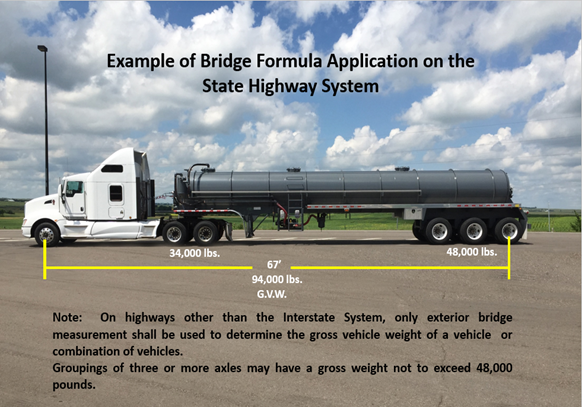
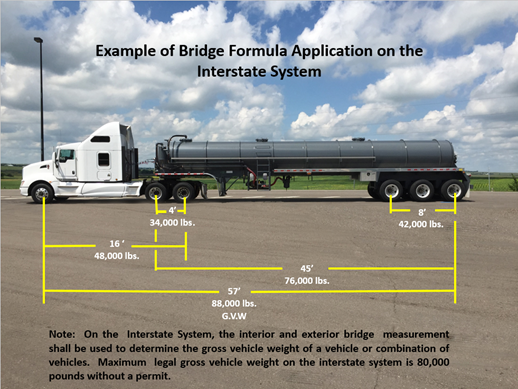
Truck weight limits are based on a formula that considers both the number of axles and the distance between the axles. Adding more axles or increasing the spacing between axles allows a vehicle to legally carry more weight.
This “bridge formula” was created by Congress and the State of North Dakota to protect bridges from excessive stress caused by heavy vehicles.
This is the formula:
W = 500 [ (LN / (N - 1)) + 12N + 36 ]
Where:
- W = Maximum weight in pounds on any group of two or more axles
- L = Distance in feet between the outer axles in the group
- N = Number of axles in the group
You don’t need to do the math yourself — the online calculator does it for you.
Information needed to use the calculator
Before starting, have this information ready:
- Type of highway (State, Interstate, or 129,000-lb Primary route)
- Total number of axles (including the steering axle)
- Number of tires per axle
- Tire width (found on the tire sidewall)
- Bridge length (distance from axle center to consecutive axle center)
- Steering axle rating (required for interstate routes)
State highway weight limits
- State highways: Maximum legal Gross Vehicle Weight (GVW) is 105,500 pounds, unless otherwise posted.
- Other highways: The maximum GVW is 80,000 pounds, unless designated for higher weights (up to 105,500 pounds).
- Tire limit: No tire may carry more than 550 pounds per inch of tire width.
Interstate weight limits
- Maximum GVW: 80,000 pounds.
- Permit requirement: An interstate permit is required if the load exceeds 80,000 pounds GVW (up to a maximum of 105,500 pounds).
- Vehicles must have the correct number of axles and bridge lengths to legally carry the load.
- The steering axle weight is determined by the manufacturer’s rating and may not exceed 20,000 pounds.
- For permit details, visit the NDHP website: www.nd.gov/NDHP.
Primary Network System
Trucks operating on designated primary network highways can haul up to 129,000 pounds GVW — provided they have enough axles and proper bridge lengths. A primary network permit is required.
All tire and axle weights must still comply with the same rules — no tire exceeding 550 pounds per inch of width.
JAKE BRAKES
If you’ve ever driven down the highway and heard a loud rumble or rapid growl coming from a semi-truck, you’ve likely heard engine compression braking. Many people recognize this sound by its common nickname, the “Jake Brake” (named after the Jacobs company that first developed the technology), though it’s often simply called an engine brake.
So, what exactly is it? When the brake pedal is pressed in a car or pickup, friction brakes are used, which means brake pads are pressing against a rotor or drum to slow the wheels. Semi-trucks also rely on friction brakes, but because a fully loaded truck can weigh up to 80,000 pounds, those brakes face a much greater challenge. Relying only on friction brakes to slow a truck of that size, especially on long downhill grades, can cause them to heat up, fade in strength, and wear out much more quickly.
This is why engine compression braking comes into play. Instead of using only the wheel brakes, this system allows the truck to use its engine to help reduce speed. It works by temporarily changing how the engine operates. Rather than burning fuel to power the pistons forward, the system uses compressed air in the cylinders to create resistance against the pistons. In simple terms, the engine is turned into a giant air pump that resists motion, helping to slow the truck. The result is strong braking power without putting unnecessary stress on the standard braking system.
So why does this matter? Engine compression braking provides several critical advantages for truck drivers. Most importantly, it improves safety by giving drivers greater control of their rigs, especially on steep or extended downhill slopes where friction brakes could overheat or fail. It also improves efficiency. Using the engine to slow the vehicle reduces wear and tear on the braking system and cuts down on costly maintenance. Finally, it increases reliability, allowing drivers to maintain a steady, controlled descent without depending solely on the foot brake. For truckers hauling tens of thousands of pounds, that reliability is a major advantage.
Of course, engine compression braking does come with one drawback: the noise. The distinctive rattling, popping, or machine-gun-like growl can be disruptive when used in towns, neighborhoods, or residential areas. That’s why “No Engine Brake” signs are posted at the entrances to many communities.
In North Dakota, this restriction isn’t just a courtesy, as of August 1, 2025, it’s now the law. The North Dakota Century Code 39-21-33.1 gives cities and counties the authority to prohibit engine compression braking in designated zones if it creates a noise disturbance. These zones must be clearly posted with signs. Drivers are prohibited from using engine compression brakes that cause excessive noise in those areas, except in emergency situations where safety demands it. Violating this statute carries a $50 fine.
On the open highway, engine compression braking is an invaluable safety tool that helps truck drivers stay in control of their vehicles; protects their equipment; and keeps roads safer. But inside city limits, respecting those posted restrictions helps maintain peace and quiet for residents—and keeps truckers from receiving a citation.
The next time you hear that familiar rumble on the road, you’ll know what it is: not a trucker “showing off,” but a piece of safety technology doing its job. When the sign says no engine brakes, it’s more than a suggestion—it’s the law.
WHEN DO I NEED A CDL?
Determining whether you need a Commercial Driver’s License (CDL) to drive a certain vehicle can be tricky, but this simplified guide—based on the below flowchart—breaks it down step-by-step. But first, what is Gross Vehicle Weight Rating?
The Gross Vehicle Weight Rating (GVWR) is the maximum weight a vehicle or trailer can safely carry, including passengers and cargo. This limit is set by the manufacturer and should never be exceeded. For most vehicles, the GVWR can be found on a label or sticker located on the driver’s side door or on the door frame. It may also be listed in the owner’s manual or available through the manufacturer’s website. For trailers, the GVWR is typically displayed on a sticker or metal plate attached to the trailer frame, often near the tongue, the part of a trailer that extends forward and attaches to the towing vehicle via a hitch, typically a ball hitch.
Do I need a CDL?
Step 1: What kind of vehicle are you driving?
- Is it a combination vehicle (like a truck and trailer)?
- ➤ Yes ➝ Go to Step 2.
- ➤ No ➝ Go to Step 3.
Step 2: What’s the weight?
- Is the Gross Vehicle Weight Rating (GVWR) of the vehicle and trailer combined, 26,001 lbs. or more, AND is the trailer rated at over 10,000 lbs.?
- ➤ Yes ➝ You need a CDL (Class A)
- ➤ No ➝ Go to Step 3.
Step 3: Is it a single vehicle (not a combination)?
- Is the Gross Vehicle Weight Rating (GVWR) 26,001 lbs. or more?
- ➤ Yes ➝ You need a CDL (Class B)
- ➤ No ➝ Go to Step 4.
Step 4: Are you transporting passengers?
- Is the vehicle designed to carry 16 or more passengers, including the driver?
- ➤ Yes ➝ You need a CDL (Class C) with a Passenger Endorsement
- ➤ No ➝ Go to Step 5.
Step 5: Are you transporting hazardous materials?
- Does the vehicle require placards for hazardous materials?
- ➤ Yes ➝ You need a CDL (Class C) with a Hazmat Endorsement
- ➤ No ➝ You do NOT need a CDL
Sometimes, specific exemptions apply to vehicles that would otherwise require a CDL. A CDL is not needed for operating an emergency vehicle or if the driver is an active-duty military member driving a military vehicle. Farmers are also exempt when using a farm-registered vehicle within 150 air miles of their farm, if the farmer is not driving for hire. Likewise, a CDL is not required to operate a recreational vehicle (RV) or camper for personal use.
SIZE AND WEIGHT
This month’s article’s focus is on the vital role of the Motor Carrier Operations division of the North Dakota Highway Patrol.
After years as a traffic enforcement trooper, I’ve recently transitioned into a specialized role as a Size and Weight Enforcement Trooper. Size and Weight Enforcement Troopers are the officers driving the NDHP three-quarter ton pickups that are equipped with portable scales. The focus of these Troopers is to ensure vehicles comply with size and weight regulations to protect roads and enhance public safety.
Motor Carrier Operations play a critical role in maintaining the safety and efficiency of highways. This division works in close coordination with the North Dakota Department of Transportation (NDDOT), the Federal Motor Carrier Safety Administration (FMCSA), and the Federal Highway Administration (FHWA). Together, we are working to uphold federal and state regulations through a mix of education, enforcement, and proactive outreach.
The goals of the Motor Carrier program are clearly defined and focused on enhancing safety, preserving infrastructure, and improving operational efficiency. The primary objective is to reduce commercial vehicle crashes by conducting thorough inspections, safety audits, and compliance reviews. Additionally, the program aims to protect the state's highway infrastructure by enforcing size and weight regulations and managing the transport of overweight or over-dimensional loads. To further support commercial transportation, the program also works to streamline operations through an efficient and effective permitting system.
Size and Weight Troopers work to implement the State’s Size and Weight Enforcement Plan and the Commercial Vehicle Safety Plan, which ensure roads remain safe, infrastructure stays intact, and transportation systems function efficiently.
As I step into this new role, I look forward to continuing my service to the people of North Dakota in a different capacity—now helping to maintain the safety and integrity of the commercial transportation network.
If you see that NDHP pickup with scales in the bed, give a wave—it’s just me, still under the trooper’s hat, doing the job a little differently now.
HANDICAP PLATES AND PLACARDS
For many American Veterans with a physical disability, daily mobility can be a challenge. To help ease some of these difficulties, North Dakota laws are in place to ensure that these Veterans have access to necessary accommodations, including designated handicap parking spaces. However, there is often confusion about whether a Veteran with a disability needs to display a separate handicap placard or if their Disabled American Veteran (DAV) license plate is sufficient.
In North Dakota, DAV license plates always begin with the letters "DAV," which stands for Disabled American Veteran. If you see a vehicle with a plate formatted as "DAV####," it signifies that the driver or an occupant is a disabled Veteran and legally can park in a handicap designated parking space.
A properly issued DAV license plate allows the Veteran to park in designated handicap parking spaces without needing a separate placard. This means that if a Veteran qualifies for a DAV plate, that Veteran is entitled to the same parking privileges as individuals with a standard handicap placard or mobility-impaired license plate.
While many assume that only the traditional blue-and-white handicap placard hanging from the mirror grants access to these parking spaces, it is important for the public to recognize that the DAV#### plate serves the same function. Veterans who display this plate are fully within their rights to park in handicap-designated spots.
To assist with handicap parking, motorists should respect designated accessible parking spaces by ensuring they are not crowded or blocked by other vehicles. It’s important not to park in these spaces unless you have a valid disability permit, even if you’re just running in for a quick errand. Additionally, always be mindful of the surrounding area, making sure there is enough space for wheelchair ramps and lifts to operate safely. Small gestures like these can make a big difference in supporting those with disabilities.
LIDAR AND RADAR
When a motorist is stopped for speeding, the driver may ask, “Can I see the radar or LiDAR (laser) reading?” Many want to confirm their speed or better understand the reason for being stopped. While officers are not required to show the reading at the time of the stop, the officer may choose to do so as a courtesy when circumstances allow. Police radar and LiDAR (laser) are speed detection tools used by law enforcement to enforce traffic laws. Radar (Radio Detection and Ranging) measures a vehicle’s speed by bouncing radio waves off a moving target and calculating the frequency shift. It can be used from stationary or moving patrol cars. LiDAR (Light Detection and Ranging uses a laser beam to pinpoint an individual vehicle’s speed with high precision by measuring the time it takes for the laser to reflect off the target. Officers typically use LiDAR in stationary positions for accurate speed enforcement, especially in high-traffic areas when identifying a single speeding vehicle.
When an officer conducts a traffic stop, the primary concern is safety—for themselves, the driver, and others on the road. Every stop carries some level of risk, and officers must quickly assess the situation. If a driver requests to see the radar or LiDAR reading, the officer will consider several factors, including the safety of the stop location, the driver's demeanor, and the need to maintain efficiency in enforcing traffic laws. Stops that occur on busy highways, blind curves, or areas with limited space may not allow for safely reviewing the reading. Additionally, a driver who remains calm and cooperative is more likely to have a positive interaction, while confrontational behavior may complicate the situation.
If conditions allow, an officer may choose to share the radar or LiDAR reading as a courtesy. While not required, providing this information can sometimes help drivers feel more informed and at ease. It’s also important to remember that radar and LiDAR readings are just one part of speed enforcement. Officers receive extensive training in visual speed estimation, which allows them to accurately assess a vehicle’s speed before activating a speed detection device.
For drivers who wish to see the speed reading, the best approach is to remain respectful and understanding. A polite request acknowledging the officer’s discretion can lead to a more positive interaction. Aggressive or argumentative behavior rarely helps the situation.
Traffic stops are not just about enforcing the law; but about keeping the roads safe for everyone. When drivers and officers approach these situations with mutual respect and understanding, the experience can be smoother, transparent and more instructive for all involved.
RIGHT OF WAY AND STOP SIGNS
Many roads in our communities lack stop or yield signs where two streets meet, which can lead to confusion when drivers arrive at the same time. So, who has the right of way?
The general rule is simple: when two vehicles approach an uncontrolled intersection at the same time, the driver on the left must yield to the driver on the right. This helps keep traffic flowing smoothly and prevents crashes.
At T-intersections without traffic signs or signals, the driver on the road that comes to a dead end must yield to vehicles traveling on the through road. This ensures that main traffic continues uninterrupted.
When approaching a stop sign, drivers must come to a complete stop at the marked line. If there isn’t a marked line, the driver should stop at the closest point where they can clearly see oncoming traffic before proceeding. Right-of-way goes to vehicles already in or approaching the intersection, as well as to drivers who arrived first at a multi-way stop.
For yield signs, drivers must slow down and be prepared to stop if necessary. If road conditions require it, the driver should stop where they have a clear view of oncoming traffic. Drivers must yield to any vehicle already in the intersection or close enough to pose a hazard. If a driver passes a yield sign without stopping and causes a crash, that driver is considered at fault for failing to yield.
Following these right-of-way rules helps keep intersections safe and traffic moving efficiently.
VEHICLE REGISTRATION SUSPENSION
North Dakota Century Code 39-04-06(1) gives the North Dakota Department of Transportation (NDDOT) motor vehicle division the power to suspend a vehicle's registration if it is deemed unsafe, unfit for operation, or fails to meet legal equipment requirements. These equipment standards are outlined in North Dakota Century Code 39-21 and North Dakota Administrative Code 37-12. Common violations encountered by law enforcement include issues with window tint, fender requirements (wide tires), mufflers and front license plates.
If the owner or operator, if previously stopped for the violation, received a warning or citation, and failed to address the violation, an officer can request NDDOT intervention to ensure compliance. In exceptional cases, if the owner or operator indicates refusal to correct the violation, the officer is not required to wait for a subsequent violation and may immediately request NDDOT action to bring the vehicle into compliance.
Once the NDDOT Motor Vehicle receives notification from law enforcement, the following action is taken:
1. A Notice to Suspend the Vehicle Registration letter is sent to the owner(s):
a. The notice states the issue and violation.
b. The notice gives the registered owner(s) 30-days from the date of the letter to correct the violation.
c. A compliance inspection sheet listing the violation(s) to be inspected is sent with the letter. The inspection sheet must be completed by a law enforcement agency. The inspecting officer must inspect the violation(s) listed and indicate either a pass or a fail. All violations must have a pass for the suspension to be stopped or removed. The officer must sign the inspection sheet.
2. If the inspection sheet is not received within the 30-day time frame stated on the letter, the vehicle’s registration is suspended until such time as the vehicle is brought into compliance, inspected, and the NDDOT is notified.
Following notification from NDDOT to the owner and the owner fails to bring the vehicle into compliance, registration is suspended. A notation is added to the owner's account, indicating the vehicle's non-compliant status. Consequently, the owner would be unable to register the vehicle for the following year(s) and the next owner could not obtain registration until the vehicle is brought into compliance.
After the vehicle has been inspected and brought into compliance, and the owner or operator again makes an adjustment to make the vehicle non-compliant, such as tinting windows past the legal percentage amount, the vehicle can be stopped, warned, or cited. The officer/agency would promptly notify the NDDOT that the vehicle is no longer compliant. NDDOT will then inform the owner of the impending registration suspension due to the vehicle being out of compliance. In this case, the suspension would take effect seven days from the date of the notification letter, allowing time for receipt. Once again, a compliance inspection sheet will accompany the notification, requiring the owner to rectify the vehicle's status before the suspension can be lifted.
Operating a motor vehicle with a suspended registration constitutes a B-misdemeanor offense and may result in the vehicle being impounded.
PEDESTRIANS, BICYCLISTS, AND EMERGENCY VEHICLES
In accordance with North Dakota's Century Code 39-10-33.2, pedestrians are obligated to yield to authorized emergency vehicles. When an emergency vehicle, whether it is a police cruiser, firetruck, or ambulance, approaches with distinct audible signals of sirens or bells and the visual display of flashing lights in blue, white, or red; pedestrians must allow the vehicle the right of way. However, this requirement does not absolve emergency vehicle drivers from their responsibility to operate their vehicles with utmost caution to ensure the safety of all road users, including pedestrians. Even when a pedestrian yields the right of way, emergency vehicle drivers must exercise caution to avoid any potential collisions with them.
North Dakota Century Code 39-10.1-02 extends traffic laws to individuals on bicycles. While bicyclists are afforded the same rights as motor vehicle drivers, they also must comply with stipulated regulations to include yielding to emergency vehicles.
When an authorized emergency vehicle approaches with its flashing lights in blue, white, or red; drivers of all other vehicles, including bicycles, are obliged to yield the right of way. Bicyclists must maneuver their bicycle to the right-hand edge or curb of the roadway, to ensure intersections are cleared, and come to a complete stop. The bicycle driver must remain stopped until the emergency vehicle has safely passed, unless directed otherwise by a law enforcement officer at the scene.
These laws are crafted with the aim of promoting safety and fostering a culture of orderly behaviors among all road users, regardless of the mode of transportation. Whether traveling on foot, bicycle, or in a motor vehicle, following these laws and regulations ensures that every journey is undertaken with due regard for the safety and well-being of all roadway users.
TITLING AND LIENHOLDERS
When transferring ownership of a motor vehicle, the owner or transferor (seller) is required to endorse an assignment and warranty of title on the vehicle's certificate of title (Part 1). This endorsement must include the name of the transferee (buyer) and, if applicable, the selling price and purchase date of the vehicle. If legal title is transferred to the buyer, the owner must provide the endorsed certificate of title to the buyer within thirty days of the vehicle's purchase date.
In cases where legal title is passed to a lienholder rather than the buyer, the transferee (buyer) must endorse a statement acknowledging the lienholder's claim and submit the certificate of title to the ND Department of Transportation (NDDOT) along with an application for a new title reflecting the names of the new owner(s) and lienholder. NDDOT will then issue the new title either directly to the lienholder or through an electronic lien notification procedure. If the seller is going accept payments for the purchase of the vehicle, the seller must list themselves as the lienholder. The seller cannot withhold delivering the title until the payment is paid in full. In this event, the seller must complete the lien process. Without the lienholder's inclusion on the title, there is no security interest in the vehicle.
A security interest is like a safety net for a lender when they give someone a loan. It means that if the borrower can't pay back the loan, the lender has the right to take something of value from the borrower to make up for the loss. For example, let's say you borrow money from a bank to buy a car. The bank may have a security interest in the car, which means if you don't make your car payments as promised, the bank can take the car back and sell it to recover the money you owe them. So, the car acts as collateral or security for the loan.
A lienholder only gains a security interest in a motor vehicle when their information is clearly stated on the vehicle's title certificate. The amount of any lien need not be shown anywhere on the certificate of title, only the fact of such lien, and the identity of the lienholder. The title is good for the life of the vehicle as long as the vehicle is owned or held by the original holder of the certificate. Once processed, NDDOT- Motor Vehicle will issue a new title reflecting the lienholder's details, which gives them security interest in the vehicle. The new title showing the lien will be sent to the lienholder.
When the lien is fully paid, the lienholder must release the lien and deliver the title within ten days to the titled owner. When the title is delivered to the transferee from the sale, within thirty days of receiving the title, the transferee must submit the endorsed certificate of title to NDDOT, along with a transfer fee of five dollars and apply for a new certificate of title. Failure to comply with these requirements may result in penalties, including the suspension or revocation of vehicle registration. NDDOT prioritizes delivering the new certificate of title to the lienholder, or if there is no lienholder, to the owner. Violation of these regulations constitutes a class B misdemeanor for the owner, lienholder, or transferee.
FMCSA Part 393: PROPER EQUIPMENT AND MAINTENANCE OF CMVS
In the vast and expansive landscapes of North Dakota, agriculture is not just a way of life; it's a cornerstone of the state's economy. Farmers in North Dakota face unique challenges, particularly when it comes to transporting agricultural goods across long distances. To ensure the safety of both drivers and the public, the Federal Motor Carrier Safety Administration (FMCSA) has established regulations, including Part 393, which governs the proper equipment and maintenance of commercial motor vehicles. North Dakota law mandates all commercial motor vehicles, including farm vehicles and trailers, comply with FMCSA Part 393. This article explores the significance of FMCSA Part 393 for North Dakota farmers and ranchers and demonstrates that compliance ensures the safe and efficient transportation of agricultural products.
FMCSA Part 393 outlines specific requirements for the design, construction, and maintenance of commercial motor vehicles. The regulation covers a wide range of components critical to the safety and functionality of these vehicles. Key areas addressed by Part 393 include:
1. Lighting Devices and Reflectors:
Part 393 sets standards for lighting devices and reflectors on commercial vehicles to enhance visibility and safety, especially during lowlight conditions or inclement weather. Properly functioning lights and reflectors are crucial for navigating the expansive roadways of North Dakota, where weather conditions can change rapidly.
2. Brake Systems:
Ensuring the reliability of a vehicle's braking system is paramount for the safety of the driver and others roadway users. Part 393 mandates regular inspections and maintenance of brakes, which contributes to the prevention of accidents and the protection of valuable cargo.
3. Tires:
North Dakota's varied terrain demands robust and well-maintained tires on agricultural vehicles. Part 393 establishes guidelines for tire condition, load ratings, and proper inflation to minimize the risk of blowouts or other tire-related incidents.
4. Cargo Securement:
Agricultural products often vary in size and shape, making proper cargo securement a critical aspect of transportation safety. Part 393 provides specifications for securing loads, ensuring that they remain stable and do not pose a hazard to the driver or other roadway users.
Why Part 393 is Applicable to North Dakota Farmers:
1. Safety First:
The vast rural landscapes of North Dakota require farmers to transport agricultural products over long distances. Adhering to FMCSA Part 393 ensures that vehicles are equipped and maintained to the highest safety standards, reducing the risk of crashes on the road.
2. Compliance with Federal Regulations:
North Dakota farmers engaged in interstate and intrastate commerce must comply with FMCSA Part 393 regulations to operate legally. FMCSA Part 393 provides a comprehensive framework that, when followed, ensures compliance with safety standards mandated by the federal government.
3. Protecting Valuable Cargo:
Agricultural products are a precious commodity, and ensuring their safe transportation is crucial for the economic well-being of North Dakota farmers. Part 393 safeguards both the cargo and the vehicles that transport them, minimizing the likelihood of damage or loss during transit.
For North Dakota farmers, compliance with FMCSA Part 393 is not just a regulatory obligation; it's a commitment to safety, efficiency, and the well-being of the agricultural industry. By understanding and adhering to these regulations, farmers contribute to safer roads, protect their valuable cargo, and uphold the high standards necessary for the continued success of North Dakota's agricultural endeavors.
2023 LEGISLATIVE CHANGES TAKING EFFECT AUG. 1
On August 1, 2023, new laws passed in the North Dakota 68th Legislative Assembly will take effect. Some of the new laws are outlined below.
Primary Seatbelt Law
In the past, North Dakota seat belts laws, other than child restraint laws, were considered a “secondary offense” meaning law enforcement officers could cite a driver for not wearing a seatbelt only after stopping them for another violation. The revised seat belt law considers the non-use of a seat belt to be a primary offense. This means if a law enforcement officer observes any person in the vehicle not wearing a seat belt, the law enforcement officer can stop the vehicle and issue the driver a citation. Each occupant in the vehicle must be seat belted, if not, the driver could be issued a citation for each person not property belted in. The fine for a seatbelt violation is $20.00.
Insurance Companies and “Points” / Driving Record
On August 1, 2023, the North Dakota Department of Transportation will be able to release all violations on a drivers North Dakota driving record to insurance companies. House Bill 1417 passed this session which removed the requirement that only violations that are 3 points or more can be released to the public (insurance companies). There are currently several violations that are less than three points that insurance companies will now have access to such as right of way violations, distracted driving violations, and speeding violations.
Turn Signal Required to Exit Rotary Traffic Island (Roundabout)
Motorists must use a turn signal before exiting a roundabout. By activating the right turn signal just prior to exiting, the driver signals their intention to other motorists that they intend to leave the roundabout.
Road Closed
The updated road closed law provides clearer language for motorists traveling on closed roads. Previously, the law stated that motorists had to knowingly pass a “road closed” sign. Often a motorist would see a “road closed” sign at one Interstate exit and drive to the next exit where there was no “road closed” sign and then enter the Interstate from there
NDHP Troopers witnessed this activity frequently this past winter. For example, a motorist would get to Bismarck and eastbound I-94 would not be accessible and have “road closed” signs in place. The motorist would then take ND Highway 10 or another back road to one of the next 10 exits east of Bismarck (Bismarck to Crystal Springs) where there were no “road closed” signs blocking the I-94 entrances and then enter I-94 from there. There was nothing law enforcement could do other than tell the motorist to exit the Interstate.
The new law states “The highway patrol or local law enforcement authorities having jurisdiction over a road may close a road temporarily due to hazardous conditions for the protection and safety of the public. If a closing is made, the authority ordering the closing shall make every reasonable attempt to notify the public and, when practical, may post appropriate official traffic-control devices to advise motorists of the closing. If a road closure has been announced to the public an individual may not drive on the road.”
The North Dakota Department of Transportation (NDDOT) and NDHP use several methods to notify the public about road closures. These methods include traditional media, social media, dynamic roadway signs, road closure barriers, and the NDRoads app or webpage. This interactive map allows motorists to access the most up-to-date road information, including road closures and road conditions. NDDOT also has a free email and mobile subscription service that provides notifications on road closures; no travel advisories; travel alerts; and other roadway-related information. Law enforcement will use common sense and reasonableness in enforcing this law. The fine for violating this law is $250.00.
ACTIVE THREATS
The North Dakota Highway Patrol’s highest priority is keeping North Dakota safe and secure by providing high-quality services. Although our focus is primarily on traffic safety, we are committed to respond to all threats to public safety, including active threat situations. Active threats are those incidents where there is an active, ongoing, serious physical threat of great bodily injury and/or death (deadly force) onto innocent people. Active threats include those involving firearms, explosives, knives, and other means. Examples of an active threat includes workplace or school shootings.
The North Dakota Highway Patrol receives training to immediately respond to any active threat situation. If there is a situation where a suspect poses the threat of great bodily injury and/or death to others and the delay in acting may result in additional injuries or death; troopers have received training to immediately act to prevent further injury or loss of life. Troopers will follow the use of force continuum as a guide for the appropriate amount of force needed to bring the situation to a swift conclusion.
There are typically three questions troopers will ask themselves during an active threat situation:
1. Has the suspect already used deadly force against someone?
2. Can the suspect still harm someone using deadly force?
3. Are there still potential victims for the suspect to use deadly force against?
If the trooper can answer “Yes” to any of the above questions, our duty is to respond and stop the threat as soon as possible.
It is important for North Dakota residents and visitors to know the NDHP will not stand idle while an active threat is occurring. Troopers have taken an oath to protect and serve and will immediately act to stop individuals who attempt to injure or kill innocent people.
CONSTRUCTION ZONE SPEEDS
Once again road construction is underway, and it is important to remind motorists of the regulations for speeding within a construction zone. Throughout North Dakota, speed limits are reduced within construction zones to allow enough time for motorists and workers to react to potentially dangerous situations.
The reduction of speed limits within a construction zone is effective for the duration of the time the area is under construction. Signs are posted within the zone to alert motorists of the reduced speed. The time of day, day of the week, or the presence of workers does not change the speed limit within the construction zone. If a motorist is traveling at 12:30 am on a Monday morning with no workers present in a construction zone that is posted at 45 mph, the motorist must travel at 45 mph or lower, and not at the original speed limit. Simply stated, the posted limit remains the limit until the posted signs are taken down following the completion of the work being done.
I conducted a traffic stop on a motorist for traveling in excess of 80 mph in a posted 55 mph construction zone. It was during the evening hours and there were no workers present. The driver thought the “normal” speed limit of 75 mph would apply. That is not the case, and the driver was cited for speeding in a 55-mph zone.
If a motorist exceeds the posted speed limit in a construction zone with workers present, there is a minimum fee of eighty dollars for one through ten miles per hour over the posted speed limit; and eighty dollars plus two dollars for each mile per hour over ten miles per hour over the limit.
ONLINE CRASH REPORT REQUESTS
Reports for traffic crashes which are “reportable” to the North Dakota Department of Transportation are available for purchase online. North Dakota Century Code 39-08-09 defines a reportable crash as a motor vehicle traffic crash which results in injury, fatality, or at least $4,000 in total property damage. Crashes involving undomesticated animals where there is no injury or fatality to a human, regardless of the property damage amount, are not reportable.
Customers will receive their report(s) immediately if the report is available for purchase. There is a $7 fee to locate and provide the crash report. You may not be able to locate a crash report if the following conditions apply:
- It has been less than 10 days since the crash occurred.
- The crash did not result in injury, fatality, or at least $4,000 property damage.
- The crash involved an undomesticated animal and there was no injury or fatality (regardless of property damage amount).
To obtain a copy of the State of North Dakota crash report, a person must be able to provide at least two of the following:
- Date of Crash
- Last Name
- County of Crash
If you don’t have this information, please contact the Law Enforcement Agency that investigated the crash to obtain these details. Crash reports can be purchased at the following website: Purchase Crash Report | NDDOT.
LARGER TIRES
Have you ever noticed vehicles with tires protruding outside the wheel wells such as jacked-up pickup trucks? Vehicles are allowed to have the tires sticking out but with limitations. North Dakota Administrative Code 37-12-02 “Special Motor Vehicles”, discusses the requirements for vehicles constructed, reconstructed, or modified from their original version.
A "Special motor vehicle" means any vehicle equipped with two or more axles having at least two wheels per axle, and which are intended for use on public highways. The term "special motor vehicle" includes the following types:
- Type I - Those vehicles which are restored to or retain their original configuration, but which may contain changed steering, brake, power train, or suspension systems.
- Type II - Those vehicles changed from the recognized vehicle manufacturer's original body configuration, but which retain the general appearance of the original vehicle. This type may include changes and modifications to engine, chassis, brake system, power train, steering, and suspension systems.
- Type III - Other than type I and type II special vehicles, those vehicles custom built with fabricated parts, or parts taken from existing vehicles.
All wheels and tires of every special motor vehicle shall be equipped with fenders that cover the entire tire tread width that meets the road surface. The purpose of fenders is to prevent the rotating wheels and tires throwing particles such as mud, rocks, sand, liquids, and other road substances into the air.
It is not uncommon to see pick-up trucks and passenger cars with tires that stick out further than normal. The tire tread must be covered by fenders or “fender flares” to be considered legal. There are also limitations on tire width. No vehicle can be operated in excess of 8’6” wide. If the tires and wheels are extra wide, the entire width of the vehicle cannot be wider than 8’6”.
A person operating a vehicle with protruding tires without fenders could be stopped by law enforcement and cited under NDCC 39-21-45.1 “Mortification of Motor Vehicle” and receive a twenty-dollar ($20.00) citation for the offense.
RENEWAL AND REGISTRATION
The North Dakota Department of Transportation (NDDOT) offers a variety of ways to renew your motor vehicle registration. In the past, the typical method was to go in person or send in renewal paperwork and fees to the local NDDOT motor vehicle office. NDDOT now offers more efficient ways to renew a motor vehicle registration.
An online option is available at mvrenewal.nd.gov for those who want 24/7 availability and want to use a credit card. In December 2020, the mobile app ND Drive was also launched. The online options are available for the renewal of existing vehicles. For a new vehicle, fleet vehicle, or a truck weighing 55,000 lbs. or more; online renewals are not an option.
The process of renewing online is simple. Typically, a renewal notice from NDDOT regarding the registration expiration will arrive in the mail or by email. It is important to ensure NDDOT has a current address, which is listed on the vehicle registration card. If you have moved and failed to notify NDDOT of the new address, the renewal notice may be sent to the old address. Contact NDDOT to change your address.
The renewal notice will identify the vehicle due for renewal and include an invoice number and website address. Once the required information is entered into the system, NDDOT will send notification if the renewal was accepted. It is recommended to print or save a copy of the receipt; just in case you are stopped by law enforcement for a registration violation. The receipt will serve as proof that vehicle registration was purchased. The new registration stickers and updated card will usually arrive in the mail within a couple of weeks.
Another quick and easy method to renew the vehicle registration is to use a NDDOT self-service kiosk which are located at many sites around the state. These kiosks are a fully automated motor vehicle registration renewal station that will dispense license plate renewal registration cards and motor vehicle tabs at the point of purchase. A vehicle owner can navigate through the easy touch screen (voice assistance available). You will need an invoice number from the mailed invoice, or title and plate number which can be found on your vehicle registration card. Once the payment has been submitted and the transaction is complete; the vehicle’s renewed registration card and stickers are dispensed directly from the machine. If the vehicle was not renewed in the previous year, the customer will need to send in their renewal or visit a Motor Vehicle office. Vehicles that require a 2290 form cannot be renewed at a kiosk. The terminals are available during business hours of the participating locations.
More information about kiosk including locations can be found at https://www.dot.nd.gov/divisions/mv/renewal-options.htm.
The 2020 registration stickers are blue; 2021 are yellow; and 2022 are red. All vehicles should have the yellow (2021) or the red (2022) displayed. Violations for expired registrations result in a penalty is a $20 citation and zero points. If the vehicle is currently registered but does not display the current registration sticker (yellow or red) the penalty is a $20 citation and one point.
RESTRICTED LICENSES FOR MINORS
The minimum driving age in North Dakota is 16 years old. However, North Dakota allows for a resident to obtain a restricted driver’s license at the age of 15 and when the driver turns 16, the restrictions are lifted. For the purposes of this article, a minor is fifteen years old with a restricted class D driver’s license.
North Dakota Century Code 39-06-17(4) outlines the restrictions that are placed on a minor. A minor with a restricted class D driver’s license may operate the type or class of motor vehicle specified on the restricted license under the following conditions:
1. The minor driver must be in possession of the license while operating the motor vehicle.
2. A minor holding a restricted class D license driving a motor vehicle may not carry more passengers than the vehicle manufacturer's suggested passenger capacity.
3. A minor holding a restricted class D license driving a motor vehicle may not operate an electronic communication device to talk, compose, read, or send an electronic message while operating a motor vehicle that is in motion unless the sole purpose of operating the device is to obtain emergency assistance, to prevent a crime about to be committed, or in the reasonable belief that an individual's life or safety is in danger.
4. A minor holding a restricted class D license may not operate a motor vehicle between the later of sunset or nine p.m. and five a.m. unless a parent, legal guardian, or an individual eighteen years of age or older is in the front seat of the motor vehicle or the motor vehicle is being driven directly to or from work, an official school activity, or a religious activity.
The restrictions also do not authorize a minor to drive a commercial truck, motorbus, or taxicab with the exception that the minor may drive a farm motor vehicle having a gross weight of fifty thousand pounds while used to transport agricultural products, farm machinery, or farm supplies to or from a farm when operated within 150 miles of the driver’s farm.
The above restrictions are indicated on the reverse side of the minor’s driver’s license.
The penalty for the fifteen-year-old driver who violates the provisions of their restricted license is $20.00 and 4 points added to their driving record. If a parent or guardian knowingly allows or causes their minor child to operate a vehicle in violation of the above restrictions, the parent or guardian can be cited and assessed a fine of $20.00 with 2 points added to their driving record.
CRASH RECONSTRUCTION TEAM (CRT)
The North Dakota Highway Patrol (NDHP) provides crash reconstruction services for motor vehicle crashes that result in death or serious injuries and have the potential for criminal charges. The NDHP treats crash scenes as potential crime scenes and completes thorough and unbiased crash investigations and reconstruction. Crash reconstruction is done to determine how and why a crash happened. This is accomplished first by interpreting the clues left by the physical evidence on the vehicles and at the scene. This evidence is used to study and reconstruct the events preceding, during, and following the crash.
The NDHP currently has fourteen members on the Crash Reconstruction Team (CRT). The members of the CRT are considered crash technicians. Technicians are specially trained and equipped to identify and gather critical evidence at crash scenes. Once they gather and compile crash evidence, it is reviewed by the CRT coordinator and may be assigned to one of the five crash reconstruction analysts. The crash reconstruction analyst will then complete a comprehensive scientific analysis of all evidence in the case by using accepted techniques to form professional opinions regarding crash causation and contributing factors.
The crash reconstruction team deals with a lot of factors, depending on the case. They answer questions such as: What events contributed to the cause of the collision? Was the driver speeding and just how fast was he/she going? Could the driver have avoided the collision? Was the passenger wearing a seat belt? Who was really driving the vehicle? Was the fatal collision an "accident" or was it a suicide? Were the brakes maintained properly and did this contribute to the crash? Why didn't the driver see the other car? Was a vehicle being driven at night without its lights on? Which driver's story is more truthful? The CRT can uncover other important aspects of a crash which had been previously missed or overlooked by others.
Along with scouring the scene for evidence, digital data such as engine control modules (ECM), airbag control modules (ACM), or crash data recorders (CDR) are devices installed in motor vehicles to record technical vehicle and occupant information for a brief period of time (seconds, not minutes) before, during, and after a crash. Some of the information which may be captured is the vehicle's indicated speed, brake pedal use, accelerator pedal input, steering wheel input, seatbelt status, airbag deployment performance information, crash severity, and many more driver inputs and vehicle system status information. This data is extremely useful to the crash reconstructionist in determining how and why the crash occurred.
You may have also driven by a crash scene where troopers are working with something that looks like surveying equipment. The equipment is called a total station theodolite which is a surveying instrument used to measure horizontal and vertical angles. When evidence is located, a trooper will hold a pole with a prism over the evidence. The instrument is focused on the prism and the operator takes a "shot" by pressing a button on the data collector. An infrared beam is shot at the prism and reflected to the instrument. The operator then enters a code for that specific shot. The trooper moves the pole to another evidence location and the process continues. The total station records the distance, angle, and elevation for each “shot” or piece of evidence. This information is extremely important for the CRT to properly reconstruct a crash.
Recently the CRT acquired small Unmanned Aerial Vehicles (UAVs) for taking measurements at crash scenes. The UAV is used to capture photographs from above. The UAV may take several hundred to several thousand overlapping photos to document a scene. The photographs are loaded into a software program which renders a 3D model of the scene using photogrammetry. CRT members who operate the UAVs are certified Federal Aviation Administration (FAA) part 107 (remote pilot certificate). Certification requires a training course on FAA rules and regulations followed by passing an FAA written exam.
Always remember to MOVE OVER and SLOW DOWN when you see emergency lights. A member of a CRT and a trooper may be on the scene of a crash collecting evidence and data.
STANDARDIZED FIELD SOBRIETY TESTING
North Dakota law not only prohibits driving “under the influence” of intoxicating liquor or with a blood alcohol of .08% or greater, but also prohibits drivers who are under the influence of any drug, or substance (or combination), to a degree that renders that person incapable of safely driving. Law enforcement officers are trained in Standardized Field Sobriety Testing (SFST) to test individuals they believe to be under the influence. The SFST is a battery of three reliable tests performed during a traffic stop to determine if a driver is impaired.
The three tests have been scientifically validated and are designed to be simple and easily performed by the average person when not impaired. The tests simulate the divided attention qualities of driving and exercise the same mental and physical attributes that a person needs to drive safely. These tests, like driving, require information processing, judgment, memory, balance, steady reactions, and coordination of limbs. The three tests that make up the SFST are the Horizontal Gaze Nystagmus (HGN), the Walk-and-Turn, and the One-Leg Stand.
Horizontal Gaze Nystagmus (HGN): The purpose of the HGN test is to observe whether nystagmus, an involuntary jerking of the eyes, is present in a suspected impaired driver. The horizontal gaze nystagmus test is considered the most reliable of all field sobriety tests because the nystagmus indicates if something is interfering with the central nervous system. The following are signs or clues an officer looks for in this test:
1. Lack of smooth pursuit –The officer should observe whether the eyes are noticeably jerking and if there is a lack of smooth pursuit;
2. Distinct and sustained nystagmus at maximum deviation – When the eye moves as far as possible and is kept at that maximum deviation for a minimum of four seconds, the officer looks for distinct and sustained nystagmus.
3. Onset of nystagmus prior to 45 degrees –The officer is looking to see whether the eye exhibits nystagmus before it has moved beyond a 45-degree angle.
There are three clues for each eye for a maximum of six clues possible. If four or more clues are present, there is a likelihood that the subject’s blood alcohol concentration is .08% or greater.
Walk and Turn (WAT): The second standardized field sobriety test is the Walk and Turn test. While the test is being administered, the police officer is looking for eight clues:
- Inability to balance during the instruction phase;
- Starting before the officer has finished the instructions;
- Stopping while walking to regain balance;
- Not touching heel-to-toe;
- Stepping off the line;
- Using arms to balance;
- Losing balance on the turn or turning incorrectly; and
- Taking the wrong number of steps.
The presence of two or more clues indicates a likelihood the subject has a BAC of .08% or greater.
One Leg Stand (OLS): While the test is being administered, the law enforcement officer is looking for four clues:
- Swaying while balancing;
- Using the arms to balance;
- Hopping to maintain balance; and
- Putting the foot down.
The presence of two (2) or more clues is a likelihood the subject has a BAC of .08% or greater.
When all three tests are used, an officer is extremely accurate in identifying impairment the majority of the time. This means that these tests are a very reliable tool in developing probable cause to arrest and proving “under the influence.”
DIRT ROAD JURISDICTION
In last month’s article I wrote about the jurisdictional authority of North Dakota law enforcement. I have received some inquiries about what “highway” means in regard to the North Dakota Highway Patrol (NDHP) and jurisdictional authority.
North Dakota Century Code (NDCC) 39-01-01 (29) lists the definition of a highway as “the entire width between the boundary lines of every way publicly maintained when any part thereof is open to the use of the public for purposes of vehicular travel and of every way privately maintained within a mobile home park, trailer park, or campground containing five or more lots for occupancy by mobile homes, travel trailers, or tents when any part thereof is open for purposes of vehicular travel.”
A highway in a rural area may be called a “road”, while a highway in an urban area may be called a “street”. Under NDCC 39-03 the NDHP has authority to protect highways and the use of them in this state and the operation of motor and other vehicles upon such highways.
There may be a misconception that NDHP troopers can only patrol the Interstate and state highway system. This is not the case. Since highways, roads, streets, alleys, and gravel / dirt roads are open to the public for vehicular traffic, troopers are responsible for patrolling and enforcing laws as these areas are considered a “highway”. I once stopped a vehicle on a gravel road and ultimately arrested the underage driver for DUI and the two passengers for minor in consumption of alcohol. They thought their cases were going to be dismissed because I cannot patrol and have no authority on gravel roads. They were legally proven wrong. Troopers patrol and respond to incidents on all roadways with the intent to provide the best coverage possible to prevent crashes, ensure safety, and assist the motoring public.
JURISDICTIONAL AUTHORITY
Jurisdictional authority relates to the authority a certain department or agency has over a location as written in the law. The jurisdictional authority of North Dakota’s law enforcement officers is outlined in the North Dakota Century Code. Each law enforcement agency has jurisdictional limitations.
The North Dakota Highway Patrol has authority over all highways in North Dakota. The NDHP enforces the laws relating to protection and use of the highways, operators’ licenses and the operation of motor and other vehicles using the highways. Troopers do not enforce city or county ordinances. For example, if a city creates an ordinance that makes having an open container of alcohol on a public street illegal a trooper cannot issue a citation for this violation because it is a specific law created by the city. Recent legislation has also provided NDHP troopers general police powers over all violations of law committed in their presence or when in pursuit of any actual or suspected law violator. Legislation has also provided general police powers over any violation of law committed on public or private property when requested by another law enforcement agency. Troopers can also respond to calls for emergency assistance requiring an immediate response which occurs outside state-owned or state-leased property, a highway, or the highway right of way, but notification must be provided to the local law enforcement agency having primary jurisdiction.
Sheriffs and Deputy Sheriffs in North Dakota have authority in all areas within their county and up to one thousand five hundred feet (1,500) outside the county. For judicial purposes, offenses committed on the boundary of two or more counties, or within five hundred yards thereof, the jurisdiction can be in either county. The county sheriff enforces the county ordinances and can only enforce city ordinances if under contract or agreement with the city.
City police officers have authority within the city limits and 1.5 miles beyond city limits to enforce state and federal laws. They also have the authority to enforce city ordinances within city limits.
You have probably seen local law enforcement officers beyond their jurisdictional limitations doing some type of law enforcement function. It is a misconception that law enforcement must stop at their jurisdictional border. The concept of “fresh pursuit” or “hot pursuit” can apply. Fresh pursuit is best defined as the pursuit of a person who has committed or who is reasonably suspected of having committed a felony, misdemeanor, or traffic violation. For example, if a municipal police officer observes a traffic violation within their city or 1.5 miles from the city line and the suspect vehicle stops well into another jurisdiction, the police officer can still arrest or issue a citation to the driver.
The location where the vehicle stops does not matter if the violation was committed within the jurisdiction of the law enforcement officer. This also applies to county sheriffs. It is common practice for law enforcement to notify the appropriate jurisdictional agency if they are beyond their jurisdictional area. For example, if a City Police Officer was chasing a fleeing suspect and the chase went beyond the city limits, they would notify the local sheriff’s office and/or the NDHP.
If a law enforcement officer has reasonable suspicion that a law was broken outside their jurisdictional boundary, the officer needs to contact the proper jurisdiction for criminal or traffic charges.
Another way law enforcement can work outside of their jurisdiction boundary is through a mutual aid agreement. A mutual aid agreement is based upon at least two law enforcement agencies agreeing to assist each other in the event of an emergency or call for service. Examples of these can include weather-related incidents such as a tornado or flood or civil disturbances such as large-scale protests. Mutual aid agreements can also be used during instances when a law enforcement officer needs assistance and another agency is able to provide assistance. For neighboring jurisdictions, municipal police officers can be deputized by the county sheriff to allow for the police officers to assist the county sheriff.
REAL ID UPDATE
I received a couple of questions regarding the REAL ID identification requirements and what exactly the REAL ID does and does not do.
According to the North Dakota Department of Transportation the purpose of the REAL ID is to implement security processes designed to reduce identity fraud and provide the highest certainty that the individual with the identity document in front of you is who he or she says he or she is. The REAL ID prohibits federal agencies from accepting driver’s licenses and identification cards from states that do not meet requirements for official purposes such as boarding an airplane or obtaining access to a federal building.
In a nutshell, it allows a North Dakota resident to use their driver’s license as a form of identification to complete domestic airline travel and access a federal facility such as a federal courthouse or airbase.
There is NO requirement to get a REAL ID. If you do get a REAL ID this means you will be able to use your driver’s license as a form of identification to complete domestic airline travel and access a federal facility. If you chose to not get a REAL ID, then you will need to use a passport for identification when traveling on any domestic airline or accessing of a federal facility.
If you do not get a REAL ID, it does not mean your driver’s license is invalid or expired. You won’t get a citation or go to jail if stopped by a law enforcement officer without having the REAL ID.
After October 1, 2020, if you plan to fly to Coolidge, KS, to visit Aunt Edna you will either need a REAL ID or a passport to get on the aircraft. If you choose to drive to visit Aunt Edna it does not matter if you have a REAL ID or not!
Once you obtain a REAL ID you do not need to show all the required documents every time you renew your driver’s license unless you have a name or address change.
More information about REAL ID can be found at the North Dakota Department of Transportation website.
FARM MACHINERY OPERATORS
I received a question whether it is unlawful for juveniles or non-licensed drivers to operate farm machinery (tractors, combines, etc.) on roadways.
According to North Dakota Century Code 39-06-01: “An individual may not drive any motor vehicle on a highway or on a public or private area to which the public has a right of access for vehicular use in this state unless the individual has a valid license as an operator.”
In conversational terms, this means anyone operating a tractor, combine or other selfpropelled farm machine on a public road MUST have a valid driver’s license in his/her possession. If an operator is solely operating the farm equipment on his/her own property and not on a public roadway, then he/she does not need to be licensed. A juvenile operating a tractor or other farm equipment under an instruction permit or a restricted license would need to adhere to all established requirements outlined in century code for that permit or license.
If a person operates a tractor on a public road without a valid operator’s license, he/she is subject to the same penalties as if operating a regular vehicle on a public road.
North Dakota State University Extension offers training for youth ages 13-15 to gain valuable experience on safely operating farm equipment. NDSU Extension will hold a Tractor Safety School May 26-28 at the North Dakota 4-H Camp near Washburn, ND. Youth will learn the rules of the road, how to read farm equipment operator manuals, and how to operate large and small tractors. Participants receive hands-on training in operating farm equipment. The training also has obstacle courses that simulate farm situations. Students who successfully complete the training earn tractor safety certification, which takes effect at age 14.
For more information regarding this youth training opportunity, please contact Rick Schmidt, NDSU Extension Agent in Oliver County and the traffic safety school’s organizer at 701-794-8748 or at rick.schmidt@ndsu.edu.
NDHP HIRING PROCESS
The North Dakota Highway Patrol (NDHP) has a four-phase hiring process for individuals who are interested in becoming troopers. Phase one is the initial application, phase two is written tests, phase three is an oral interview and written personality test, and phase four is a background investigation. This intense process is to ensure individuals hired meet requirements and can demonstrate the core values of the NDHP:
- Loyalty: We will show allegiance to ourselves, our department, the state of North Dakota, our community, and to those who came before us and sacrificed so much to ensure the safety of our citizens.
- Integrity: We are honest, responsible, and ethical. Citizens place the highest trust in the NDHP. Each member must recognize that they are held to a higher standard of accountability than the public. We must always be mindful to NEVER violate the public trust. Our conduct, both on and off duty, must be beyond reproach.
- Commitment: To fulfill the vision of the NDHP, each employee must deliberately carry out their duties and responsibilities to the best of their abilities.
- Respect: Because we are a diverse culture, we value each other and all members of our community regardless of age, race, gender, appearance, individual beliefs or lifestyles. We will always show understanding, respect, and appreciation for our similarities and differences.
- Professional: As professionals, we must conform to the technical and ethical standards of our vocation. Because we are highly trained and dedicated, we are capable of handling the daily demands of law enforcement and devoting our full energy and talents to the department’s vision.
- Accountability: Employees at all levels and ranks must accept responsibility for their actions both in their personal life and in their professional life.
According to the National Advisory Commission on Criminal Justice Standards and Goals, the need for public trust, respect, and confidence in the police service, and the responsibilities entrusted to police officers, preclude the employment of the dishonest, immature, lazy, immoral and unreliable. A background investigation is the collection and evaluation of information concerning an applicant's prior life including their family history, education, employment, military service, former residences, any organization memberships and/or affiliations, personal and professional references, temperament (violence), alcohol and drug use, driving history, finances, criminal and civil litigation, emotional health, character, and integrity. An applicant’s background must not call into question their ability to fulfill the functions of a law enforcement officer.
The purpose of the background investigation is first to learn about a candidate’s past behaviors under a variety of circumstances. According to Dr. Chuck Russo in Demystifying the Background Investigation Process: What You Can Expect When Applying for a Law Enforcement Job, “We still haven’t found a way to accurately predict future behavior. All that can be done is to review past behavior and decision making to determine a likelihood of performance and action of future behavior.”
Secondly, the investigation serves to verify the applicant’s verbal and written statements to the law enforcement agency. The most common reason an applicant is rejected from the background investigation process is for being untruthful or failing to disclose unfavorable things about themselves. It is important for the applicant to understand that all people have made mistakes. No one is perfect. It is important for applicants to be open and honest about their past. Typically, those who fully disclose even the most embarrassing things will have an increased chance of passing the background investigation.
North Dakota Administrative Code (109-02-01-02) requires the [employing law enforcement] agency shall conduct a criminal history background investigation when the agency hires or appoints an individual to perform peace officer duties. The agency shall submit a complete set of the individual's fingerprints and all other information necessary to complete a state and nationwide criminal history record check with the Bureau of Criminal Investigation. This law mandates the employing agency must only complete a state and federal criminal history check on an applicant and not a comprehensive review of their history and character. The NDHP always completes a detailed, complete background investigation on all applicants prior to a conditional offer of employment.
For further information regarding the North Dakota Highway Patrol hiring process visit https://www.nd.gov/ndhp/careers/ndhp-trooper-hiring-process
References:
Russo, Dr. Chuck (2014, February 4) InPublicSafety.com; Demystifying the Background Investigation Process: What you can expect when applying for a law enforcement job. Retrieved from https://inpublicsafety.com/2014/02/demystifying-the-backgroundinvestiga… United States. National Advisory Commission on Criminal Justice Standards and Goals - 1973 - Law enforcement
SCHOOL BUS SAFETY
With school back in session, it’s important for motorists to use caution when children are getting on or off a school bus. According to the National Highway Traffic Safety Administration, children are safer riding on school buses than in private vehicles. The most hazardous times for children who ride a school bus is when they are getting on and off a bus.
According to North Dakota Century Code 39-10-46, the driver of a vehicle meeting or overtaking from either direction any school bus stopped on the highway shall stop the vehicle before reaching the school bus. The school bus must have its flashing red lights or the stop sign on the control arm activated. The driver of a vehicle may not proceed until the school bus resumes motion, the driver is signaled by the school bus driver to proceed, or the flashing red lights and the stop sign on the control arm are no longer activated.
The driver of a vehicle upon a highway with separate roadways need not stop upon meeting or passing a school bus which is on a different roadway.
Every school bus must be equipped with a stop sign or a control arm and red visual signals. The stop sign or red lights may only be activated by the driver of the school bus when the vehicle is stopped on the highway to receive or discharge schoolchildren.
School Bus Evacuation Drills
There is currently no state law requiring bus evacuation drills be taught to students. The North Dakota Department of Public Instruction (NDDPI) provides guidance to schools on bus evacuation drills in the emergency procedures section of the School Bus Driver’s Guide located on the NDDPI website. This is the guidance given to schools on school bus evacuation drills.
- All children should be given an opportunity to participate in evacuation drills including those children who ride only on special trips.
- All children should be instructed in school bus passenger safety and procedures for emergency evacuation prior to participation in evacuation drills.
- School bus evacuation drills should be held more often during fall and spring months.
- Drills should be held in restricted off-street areas and not on bus routes.
- All types of emergency evacuations should be practiced with emphasis on utilizing the rear emergency exit.
- At least once each school semester, provide all students transported to and from school in a bus with instruction on the location and operation of all emergency exits and provide them supervised emergency exit drills.
- Before departure of each school activity trip, provide all students transported on a school bus or school-chartered bus with instruction on the location and demonstration of the operation of all emergency exits.
It’s important for school children to be familiar with the evacuation process in the event of a crash or rollover. The lack of knowledge and training about emergency exits on school buses could easily result in additional injuries or death due to lack of emergency exit training.
LASER/RADAR DETECTORS, DOUBLE YELLOW LINES, AND TRAILER REGISTRATION
Radar / Laser Detectors
The use of radar / laser detectors is legal in the State of North Dakota in non-commercial motor vehicles. The use of a radar detector in a commercial motor vehicle is a violation of state and federal law.
Although using a radar detector is legal, it may not be viewed favorably by law enforcement. The presence of a radar detector can be mentioned by an officer during court if an individual chooses to contest the citation. Law enforcement will often know when a radar / laser detector is being used. After an officer activates a radar / laser the speed of the target vehicle can be observed dramatically decreasing. At night there is also a noticeable dip in the target vehicles headlights when the driver suddenly applies the brakes to slow down.
Double Yellow Lines
There have been questions raised regarding the use of double solid yellow lines in smaller communities. These lines are usually on a “Main St.” prohibiting vehicles from turning left and into a parking stall. These double solid yellow lines are known as the ‘no-passing’ lines indicating no passing or driving to the left of the double solid yellow line.
North Dakota Century Code 39-10-15 allows for local authorities to determine portions of roadway under their jurisdiction where crossing to the left side of the roadway would be hazardous. For example, on Main Avenue in Napoleon there are double solid yellow lines and no U-turn signs prohibiting vehicles traveling in one direction to turn left into a parking spot on the other side of the road. All vehicles need to turn right into a parking spot. When vehicles back out of the parking spot they need to proceed in the same direction they were originally traveling.
For a local jurisdiction to enforce this law, there must be appropriate signs or markings on the roadway, which are clearly visible to an ordinarily observant person, indicating the beginning and ending of such zones. No driver may at any time drive on the left side of any pavement striping. The exception to this rule is when the driver of a vehicle is turning left into or from an alley, private road, or driveway.
When must trailers be registered?
According to NDCC 39-04-18(2)(M), any trailer, semi-trailer, or farm trailer when the gross weight, not including the weight of the towing vehicle, exceeds one thousand five hundred pounds and it is for hire or commercial use must be registered and have a license plate. A trailer is also required to be registered when used to transport recreational vehicles or boats and it is for hire or commercial use.
If a person uses a trailer for commercial use, the trailer must be registered. If a handyman or a local lawn service uses a trailer to haul grass clippings, mowers, etc., and they are compensated for it, then the trailer must be registered.
Semi-trailers and farm trailers may be “permanently” registered for a one-time fee of $120 until the semi-trailer or farm trailer is sold or destroyed.
CONCEALED CARRY AND CONSTITUTIONAL CARRY
I have received numerous questions about the North Dakota concealed carry and constitutional carry laws. This article will address only the basics and it is recommended to research the North Dakota Century Code Title 62.1 or consult with your personal attorney for further information.
According to North Dakota Century Code, concealed is defined as:
A firearm is concealed if it is carried in such a manner as to not be discernible by the ordinary observation of a passerby. There is no requirement that there be absolute invisibility of the firearm or dangerous weapon, merely that it not be ordinarily discernible. A firearm is considered concealed if it is not secured and is worn under clothing or carried in a bundle that is held or carried by the individual, or transported in a vehicle under the individual's control or direction and available to the individual, including beneath the seat or in a glove compartment.
An unloaded firearm is where the chamber of the firearm does not contain a loaded shell. If the firearm is a revolver, then none of the chambers in the cylinder may contain a loaded shell.
CONSTITUTIONAL CARRY
The following are the eligibility requirements for an individual to carry concealed in North Dakota without a concealed weapon license, known as constitutional carry.
- Must be at least 18 years of age. Must be 21 to purchase a handgun but may possess at age 18 in North Dakota provided individual is legally able to possess a firearm under the law.
- Must be a resident of North Dakota for 1 year as evidenced by North Dakota driver’s license or North Dakota identification card.
- Not prohibited by state or federal law from possessing a firearm.
- North Dakota driver’s license or North Dakota identification card MUST be carried (or the individual must have a digital image of the license).
- If carrying under “constitutional carry”, the individual MUST inform law enforcement that they are in possession of the firearm upon any in-person contact by a law enforcement officer including traffic stops.
- Restrictions on location (places) that a firearm may be possessed or carried by law (NDCC Title 62.1-02) still apply. These locations include retail sales of alcoholic beverages and the locations where the consumption of alcoholic beverages occur, as well as, public gatherings (athletic or sporting events, a school, a church, and a publicly owned or operated building).
- An individual may keep a loaded, concealed firearm in a vehicle provided they show valid identification and notify law enforcement that they are in possession of a firearm.
- Constitutional Carry only allows the concealed carry of a firearm by a North Dakota resident within the boundaries of North Dakota. You will need a concealed weapon license to carry concealed outside of North Dakota. Reciprocity with other states may apply only if you possess a valid concealed weapon license.
Concealed Weapon License
There are two types of concealed weapons license in North Dakota: Class 1 and Class 2. The licenses cost the same and are equally valid within North Dakota, but because of the additional testing requirements, the holders of a Class 1 license have reciprocity in many more states than those who hold a Class 2 license.
For further information on concealed weapons license or how to obtain one, visit the North Dakota Attorney General’s website.
Hunting with a Loaded Firearm in a Vehicle
An individual who is in the field engaged in the lawful hunting of big game or small game may not keep or carry a loaded firearm in or on any motor vehicle, including an off-highway vehicle or snowmobile. A person who violates this law is subject to a non-criminal offense. This includes those individuals carrying under the “constitutional carry” and concealed carry provisions.
RURAL BICYCLE SAFETY
For bicyclists around the country, North Dakota offers beautiful views of vast prairie with meandering, winding roads to travel on. During the warmer months, we tend to see an influx of bicyclists traveling through and spending time resting in our little communities. We all enjoy talking to and learning from these two-wheeling explorers and look to provide them with an opportunity for safe travels as they pass through our state and move on to their next destination.
It is important to remember that bicyclists have the same rights as a motor vehicle. The laws that apply to motor vehicles also apply to bicycles. Bicyclists are required to ride as near to the right side of the roadway as practical, exercising due care when passing a standing vehicle or a vehicle proceeding in the same direction. If there is a group of bicyclists riding on the roadway, they may not ride more than two abreast, except on paths or parts of roadways set aside for the exclusive use of bicycles. Bicyclists are allowed to travel on the Interstate system to include I-94 and I-29.
One of my greatest fears is if an inattentive motorist collides with a bicyclist on a rural roadway. The point I cannot stress enough is to pay attention to your surroundings. Distractions such as talking on the phone, using social media apps, texting, eating, reading, and talking to others reduces the amount of attention you are paying to your surroundings and approaching hazards. Saying “I never saw them” is not an excuse if you hit someone while driving.
Pay attention and be prepared to slow down when approaching a hill crest as there may be a bicyclist on the other side. A motorist may be unable to see what is on the other side and may suddenly come upon a bicyclist, resulting in the need to make a quick decision on how to respond.
When you come up on a bicyclist, slow down and pass them safely. Attempt to get as far away from them as possible and leave plenty of distance before you return to your traffic lane. Use extreme caution when traveling with wide loads, wide mirrors, and trailers when passing and returning to your travel lane. If there is oncoming traffic and you are unable to pass the bicyclist, do not crowd or harass them. They have the same right to be on the road as you do. Let’s provide a positive image of North Dakota and help us to achieve #VisionZeroND.
ANHYDROUS AMMONIA
Anhydrous ammonia is one of the most commonly-used nitrogen fertilizer sources in North Dakota. It plays a vital role in the production of high-quality food and feed. Anhydrous ammonia is classified as a hazardous material, although few problems occur when it’s properly handled, transported, and applied.
The North Dakota Department of Agriculture (NDDA) is dedicated to protecting human safety and the environment through regulating anhydrous ammonia nurse tanks. The NDDA is the lead agency for enforcing state laws and administrative rules relating to anhydrous ammonia. The NDHP enforces state and federal regulations relating to hazardous material transportation, including nurse tanks, on state highways.
These requirements, found in North Dakota Century Code (N.D.C.C.) Chapters 19-20.2 and 39-21-44, North Dakota Administrative Code (N.D.A.C) Article 7-12, Article 38-03-02-01, and Code of Federal Regulations Title 49 Parts 107-180, include design, maintenance, and safety equipment requirements for anhydrous ammonia storage facilities and nurse tanks. These requirements protect anhydrous ammonia users and ensure nurse tanks are safe to transport on North Dakota roadways.
State and federal regulations require anhydrous ammonia nurse tanks be in good condition and constructed with ASME materials. This checklist does not reflect all requirements for nurse tanks but is a general outline that can be easily checked. Every nurse tank must have the following:
- Readable data plate or tested and marked in accordance with Federal Regulation
- Legible North Dakota Department of Transportation (NDDOT)-approved decals and placards: “ANHYDROUS AMMONIA,” “INHALATION HAZARD” and “1005” on each side of tank
- Capacity of 3,000 gallons or less
- Legible transfer decal
- Tanks numbered and identified with name and contact information of the owner
- Slow moving vehicle emblem
- No more than 10 percent of surface rusted or missing paint
- Properly working valves and caps
- All hoses up-to-date and not damaged or cracked
- Tires in serviceable condition (no cords showing)
- Five gallons [18.93 liters] of clean water in a container on the nurse tank
- All pressure valves set to standards and in good working condition
- Operational liquid level gauge
- Pressure gauge designated for anhydrous use and graduated from 0 to 400 psi
- Safety chains and hooks (2) in good condition
- Appropriate hitch pin
- Wagon tongue and undercarriage in good condition
- Breakaway protection when tanks are hooked back-to-back in tandem
The maximum speed for a vehicle pulling a nurse tank is 25 mph with a penalty of a $250 fine.
No more than two nurse tanks can be pulled at once and the overall load length cannot exceed 75 feet. When towing two nurse tanks, the power unit must be capable of safely towing and stopping the combination. The most appropriate travel time is between sunrise and sunset; however, one anhydrous ammonia nurse tank may be towed between sunset and sunrise but must be equipped with taillights, turn signals and brake lights.
A commercial driver of a vehicle towing a nurse tank needs a CDL to operate the vehicle. The number and size of the nurse tanks will determine the class of license required, in addition to tank and HM endorsements. A driver with a restricted CDL may only tow one nurse tank. Any drivers normally exempted from CDL requirements can claim those exemptions while transporting nurse tanks.
Personal protective equipment (PPE) is required when working with anhydrous ammonia to prevent personal injury. Required PPE includes protective gloves and Z87-rated safety goggles. Every tank must have a safety can to house the gloves and goggles. State law also requires all nurse tanks have five gallons of clean water available in a container with a serviceable water hose.
If a spill occurs, stay away and immediately call 911. If you need to approach, only do so from upwind.
For specific requirements in towing anhydrous ammonia nurse tanks, visit the North Dakota Department of Agriculture webpage and search for anhydrous ammonia regulations.
REAL ID
Passed by Congress in 2005, the REAL ID Act enacted the 9/11 Commission’s recommendation that the Federal Government “set standards for the issuance of sources of identification, such as driver's licenses.” The ND state legislature passed, and Governor Burgum signed the final implementation bill for REAL ID during the 65th Legislative Session in 2017.
What does a REAL ID Driver’s License do?
- It allows a North Dakota resident to use their driver’s license as a form of identification to complete domestic airline travel and access a federal facility such as a federal courthouse or airbase.
What does REAL ID not do?
- It does not create a federal database or federally controlled or issued identification document. The U.S. Passport does that.
- It does not replace a passport used for international travel such as visiting Canada or other countries.
When do I need to have a REAL ID driver’s license?
- Your present license remains valid until its expired date, as North Dakota has received a waiver from the US Department of Homeland Security. This means your current ND driver’s license and identification card is accepted for access into federal facilities, including military installations and boarding aircraft until October 2020.
What does the Opt-In feature mean?
- The Opt-In Opt-Out feature enables you to have a choice on whether you want to get a REAL ID driver’s license or not. If you choose to Opt-In you will be able to use your driver’s license as a form of identification to complete domestic airline travel and access a federal facility.
- The Opt-Out feature also lets you choose to Opt-Out of the REAL ID process and not obtain a REAL ID driver’s license. This means you will see no change in how you currently renew your driver’s license and you will not receive a REAL ID driver’s license. Some people may choose to Opt-Out because they plan to use their passport for identification when traveling or they don’t plan on doing any domestic airline travel or accessing of a federal facility.
To obtain a REAL ID compliant driver license, permit, or ID card you must present proper documentation. The following documentation from each category 1, 2, and 3 is required:
Category 1
1. Proof of Identification All individuals applying for a permit, license, or Identification card must show proof of identity, date of birth, legal presence in the United States, by presenting one of the documents listed below. As a reminder, no photocopies; no hospital certificates; all documents must be original or certified copies only: • U.S. birth certificate (state certified; Government issued) • Valid, unexpired U.S. passport • Report of Birth Abroad issued by the U.S. Department of State • Certificate of Naturalization • Certificate of Citizenship • Valid, unexpired Permanent Resident Card • Valid, unexpired Employment Authorization Card • Valid, unexpired Foreign Passport with I-94 • I-94 Card stamped Refugee or Asylee
Category 2
2. Proof of your social security number by presenting one of the documents listed below: • Social Security Card (the actual blue and white paper card) • W-2 Form • SSA 1099 Form • Non-SSA 1099 Form • Pay stub (must contain name and social security number)
Category 3
3. Proof of North Dakota residence address by presenting one document from List A and one document from List B OR two documents from List A:
List A
- A government issued property tax form
- Mortgage/Lease/Rental document
- Homeowners/renter’s insurance policy
- Utility bill (electricity, gas, water, sewer, cable, recycle)
- Residential non-cellular telephone bill
- Parent’s proof of address for a minor child
List B
- North Dakota Driver’s License, ID Card, or Permit
- Valid North Dakota Vehicle Registration or Vehicle Title
- Transcript or report card from accredited school
- Statement from a financial institution (bank, credit union, or other financial institution)
- Credit, debit, or charge card statement
- Pay stub or statement from employer
All documents must contain your name and current physical residence address. A Post Office (PO) box address is NOT acceptable for a residence address. No photocopies are allowed. All documents must be original or certified copies only.
For more information, review NDDOT Real ID webpage: https://www.dot.nd.gov/driver/real-id-information
CITIZEN QUESTIONS
I have received a couple of questions from readers and I will address them for this month’s article.
If you're passing someone on a two-lane highway, are you allowed to exceed the speed limit until you're able to return to the right lane?
North Dakota law does not allow for a vehicle to exceed the posted speed limit when passing another vehicle traveling in the same direction. If you decide to pass another vehicle and exceed the posted speed limit while doing so, you are subject to being stopped by law enforcement and may receive a warning or citation. More information about North Dakota speeding laws can be found in the North Dakota Century Code chapter 39-09.
Can anything be done about farmers going down the highway with those HUGE headers attached to their combines? (or does someone have to be injured first?) What are the rules for traveling after dark with farm equipment?
These are great questions that I get all the time from motorists who are concerned about large implements of husbandry, usually combines with headers, traveling on roadways.
Our current law, North Dakota Century Code (N.D.C.C) 39-12-04, states that the legal width on all highways is 8 feet 6 inches; however, exemptions in law are made for implements of husbandry being moved by resident farmers, ranchers, dealers and manufacturers between sunrise and sunset. Nighttime travel is allowed, provided the implements are properly lighted and not being moved on the interstate highway system.
The requirements for nighttime travel for an implement of husbandry can be found in N.D.C.C. 39-21-15: Lamps, reflectors, and reflective materials on farm tractors, farm equipment, and implements of husbandry.
If a load width is greater than 8 feet 6 inches, red or bright orange flags (18” by 18”) must be displayed on the front and rear of the load and on the traffic side. If there are no flags, then the vehicle can be followed by a pilot car, to the rear, with flashing lights. The towing vehicle may have a lighted rotating or flashing amber lights that are visible from the rear for a minimum of five hundred feet.
If a load is greater than 14 feet 6 inches wide, the load must have a red or bright orange flag (18” x 18”) mounted on a pole showing the extreme outside width and height on the traffic side. If there are no flags then the towing vehicle shall have a lighted rotating flashing amber light which is visible from the front and rear for at least 500 feet. If pilot cars are used, then there must be one pilot car to the front and one to the rear. Both need to be equipped with a rotating or flashing amber light.
These requirements are the same for tractors, implements of husbandry and combines traveling on the roadway with headers on.
NORTH DAKOTA'S POINT SYSTEM FOR DRIVERS
The “point” system implemented by the State of North Dakota allows for drivers to accumulate points on their driving record before any administrative sanctions. Driving violations carry a monetary fine and may also have a set number of points which are added to a driver’s record.
The points assessed vary depending on the severity of the traffic violation. For example, if you run a red light or fail to stop at a stop sign, you will be assessed two (2) points. If you fail to register your motor vehicle (expired tabs), it will be zero (0) points. However, if your vehicle is registered, but you have not put the current tabs on the license plate, you will be assessed one (1) point. Many equipment violations listed under the 39-21 chapter of the North Dakota Century Code are zero (0) points.
View a complete listing of violations and associated points.
When a driver accumulates twelve (12) or more points, the North Dakota Department of Transportation (NDDOT) will suspend the driver’s license. The length of the suspension depends on the total number of points assessed on the license. If the points are exactly twelve (12), the driver will lose his or her license for seven (7) days. Each additional point over twelve (12) results in a suspension of an additional seven (7) days. After serving a suspension, the driver pays a fee to NDDOT to reinstate his or her license.
It is important to note the NDDOT will also suspend a driver’s license for alcohol or drug related driving offenses.
The NDDOT will reduce a driver’s total points by one point for every three months without a point-related violation. If a driver commits a point-related violation, the three months will start over again. For example, if you have 4 points on your driving record, it will take one year without a point-related violation to return to zero points.
JUVENILE DRIVERS
North Dakota has special provisions for young drivers regarding driver’s license points. If an adult driver has twelve (12) or more points assessed against their record, the result is a driver’s license suspension of seven (7) days for each point over eleven (11). For a driver under the age of 18, the point limit decreases to five (5). Any points above five carries significant driver’s license consequences for the minor.
According to North Dakota Century Code 39-06-01.1, the North Dakota Department of Transportation (NDDOT) shall cancel the driver’s license of a minor who has committed acts resulting in an accumulated point total in EXCESS of five (5) points or has committed an alcohol or drug related offense while operating a motor vehicle. If the minor’s license is cancelled, it is deemed the minor to have never had a driver’s license to operate a motor vehicle and may not issue a driver’s license to operate a motor vehicle other than an instruction permit or a restricted instruction permit after the completion of any period of suspension or revocation.
After the issuance of an instruction permit or restricted instruction permit, NDDOT may not issue a driver’s license to the minor until the minor has successfully completed the requirements of North Dakota Century Code 39-06-17. These requirements include the successful completion of an approved classroom or online driver's education course and behind-the-wheel instruction. The minor must also accumulate a minimum of fifty hours of supervised, behind-the-wheel driving experience in various driving conditions and situations.
In essence, a minor who commits violations which add up to 6 or more points or have any alcohol or drug related offenses while operating a motor vehicle will lose their license. They will be unable to get their license back until they retake and pass the written test, go through driver’s education again, hold their permit for the required time as stated in North Dakota Century Code 39-06-04(4) and retake and pass the driving test.
Minors and their parents / guardians should be cautious regarding point accumulation and / or drug and alcohol violations. For a complete listing of the traffic offense point schedule, visit the North Dakota Department of Transportation website: https://www.dot.nd.gov/divisions/driverslicense/dlpoints.htm.
ENTRAPMENT
Nearly every state trooper, at some point in their career, will be accused of entrapment by a person stopped for a traffic violation. Often the person alleging entrapment does not have a clear legal understanding of entrapment. To many, it is a legal buzzword taken from a television drama used as an attempt to get out of a ticket or even to intimidate a law enforcement officer.
According to North Dakota Century Code 12.1-05-11 (2), entrapment occurs when “the law enforcement agent induces or encourages and, as a direct result, causes another person to engage in conduct constituting such a crime by employing methods of persuasion or inducement which create a substantial risk that such crime will be committed by a person other than one who is ready to commit it.”
One example of entrapment would be when an officer encourages two motorists to engage in a street race. Once the race is completed, the officer arrests both for reckless driving.
Another example would occur if you are approached by someone in a bar that pressures you to buy drugs. You say, “No, I don’t do drugs.” But he keeps pressuring you to buy because the drug money is going to treat a sick family member. You buy the drugs and then arrested because he is an undercover officer.
I was once accused of entrapment by a driver traveling more than 100 mph south of Napoleon. I had been parked at a low point between two hills. The driver stated I was entrapping him by being parked in an area where he could not see me when he crested the hill. He was unable to explain to me how I encouraged and enticed him into making the decision to speed by being parked there.
When police set up a “speed trap,” it is not entrapment. Police are not enticing motorists to speed or commit traffic violations. Upon seeing a law enforcement vehicle, many drivers reduce speed as the site of the vehicle reminds them to comply with speed limits. Law enforcement officers catch violators, who under their own free will, decide to speed or commit another traffic violation. Usually a “speed trap” is simply extra patrol located where frequent violations occur, crashes have resulted from violations, or issues have been brought to the attention of law enforcement by concerned citizens.
If a law enforcement officer has actively lured you or encouraged you to break a law that you otherwise would not have committed, entrapment is a valid defense in court.
CDLS AND ALCOHOL RELATED OFFENSES
Professional drivers who hold a commercial driver’s license (CDL) are held to a higher standard and face stricter penalties towards their CDL regarding alcohol related offenses. These penalties apply to CDL holders while operating a commercial motor vehicle (CMV) as well as to their non-commercial motor vehicle (personal vehicle).
The Federal Motor Carrier Safety Administration (FMCSA), who develops standards to test and license CMV drivers, established 0.04% as the blood alcohol concentration (BAC) level at or above which a CDL commercial motor vehicle operator, is deemed to be driving under the influence of alcohol and subject to loss of CDL privileges. Most states have established a BAC level of .08% as the level at or above which a person operating a personal motor vehicle is deemed to be driving under the influence of alcohol. Sanctions for alcohol-related driving violations may affect the driver's qualification and eligibility for both commercial and non-commercial licenses.
If you hold a CDL in North Dakota and are convicted of driving while under the influence of alcohol or being under the influence of a controlled substance or you refuse to be tested while operating a non-commercial (personal) motor vehicle, you will be disqualified from operating a commercial motor vehicle for one year. For a second or subsequent conviction of driving while under the influence or being under the influence of a controlled substance or refusal to be tested while operating a non-commercial motor vehicle, you will be disqualified from operating a commercial motor vehicle for life.
If you operate a commercial motor vehicle and are under the influence of alcohol with an alcohol concentration of 0.04 or greater, your CDL or permit will be disqualified from operating a commercial motor vehicle for one year. For a second or subsequent conviction of driving while under the influence or being under the influence of a controlled substance or refusal to be tested while operating a commercial motor vehicle, you will be disqualified from operating a commercial motor vehicle for life.
The penalties described above are separate from the regular driver’s license penalties issued by the North Dakota Department of Transportation. The regular driver’s license penalties may be longer or shorter depending on the circumstances of the case. There may be a point when you are again able to drive your personal vehicle but not a CMV.
More information regarding the disqualification of commercial driver’s licenses can be found at the Federal Motor Carrier Safety Administration website www.fmcsa.dot.gov, under part 383.51 or in North Dakota Century Code under chapter 39-06.2: Commercial Driver’s Licenses.
DVR STICKERS AND CRASHES
If you have been involved in a motor vehicle crash, which has resulted in at least $1,000 in property damage, you have probably received a Damage Vehicle Release (DVR) sticker from the law enforcement officer who investigated the crash. Every motor vehicle crash in North Dakota which results in property damage of $1,000 or more, injury, or death MUST be immediately reported to law enforcement. The only exemption is when a crash involves an undomesticated animal (deer, moose, squirrel, etc.) resulting in property damage only to the driver's vehicle, regardless of the amount of damage to that vehicle.
The DVR sticker has information to include the date of crash, vehicle’s license, damage location, investigating officer and agency, and an identification number. All DVR sticker identification numbers must be indicated on the state crash report by the law enforcement officer submitting the report.
The DVR sticker is designed to notify towing companies and auto repair shops that the vehicle damage and crash were reported to law enforcement. If any vehicle with damage of at least $1,000 is brought into a repair shop without the DVR sticker attached to the vehicle, the person in charge of the shop must notify law enforcement within 24 hours after the vehicle is received and before any repairs are made to it (ND Century Code 39-07-12). The repair shop must provide the registration number, name, and address of the owner, operator or person in control of the vehicle, along with a description of the location and type of damage to the vehicle and any missing parts.
If a tow truck is used to tow a crashed vehicle to a private residence or business other than a repair shop, and the vehicle shows evidence of having been involved in a reportable crash, the towing operator must make a report to law enforcement within 24 hours providing the same information as above (ND Century Code 39-07-13).
If a vehicle has the DVR sticker attached to the window, the repair shop and / or towing company do not need to make a report to law enforcement and may tow or begin repairs immediately. Any person in charge of a repair shop or the operator/person in charge of a towing company who fails to report a vehicle which does not have the DVR sticker for a reportable crash is subject to a fine (ND Century Code 39-07-06).
FINES AND FEES
NDHP Troopers often get comments from motorists when issuing a citation that we are just, “raising revenue for the state” or “funding a new NDHP office toaster?” Most residents truly don’t know where the money from traffic and criminal fines go. The following information may dispel common misconceptions about financial revenue from citations and arrests.
It is important to note this article only address fines submitted to the district courts (counties). All citations issued by North Dakota Highway Patrol troopers are processed by district courts. Municipalities (cities) have the option to set their own fines for violation of city ordinances. Those fees can be directed into a general or set fund.
According to the North Dakota State Constitution Article IX section 2, revenue obtained from ALL fines for violation of state laws must be faithfully used and applied for the benefit of the common schools of the State of North Dakota. This money must never be diverted, even temporarily, from this purpose or used for any purpose other than the maintenance of common schools. When a NDHP trooper writes a $20.00 ticket for failure to stop or arrests a DUI suspect who is then found or pleads guilty, the revenue collected from the associated fines goes directly to the State School Fund. At no point, does law enforcement monetarily benefit from tickets written or arrests made.
Each month, the county Clerk of Court or Treasurer from all counties, forwards the money collected through fines to the State Treasurer. The State Treasurer places all the collected revenue into the State Tuition Fund. According to Ryan Skor, Director of Finance – Office of State Treasurer, “The money in that fund is then transferred to the Public Instruction Fund, which is overseen by the Department of Public Instruction (DPI). DPI then uses all of this money as part of their formula payments out to the school districts across the state.” This means that fines directly benefit the students and schools in North Dakota.
According to Skor, the amount collected by the State Treasurer and transferred to the State Tuition Fund during fiscal year (July-June) are as follows:
- Fiscal Year 2016 - $6,945,205.53
- Fiscal Year 2017 - $5,511,246.91
- Fiscal Year 2018 - $6,055,397.45
For fiscal year 2018 (July 1, 2017- June 30, 2018), counties submitted the following amounts of fines and fees to the ND State Treasurer:
- Emmons County: $31,815
- Kidder County: $42,608
- Logan County: $13,188
- McIntosh County: $16,391
If you have been caught on the wrong side of the law and were required to pay a fine, there may be some solace knowing that your money went into our state’s educational system.
BIKE SAFETY
Summer brings more outdoor activities for both adults and children. One popular activity is biking. There are bicyclists who travel cross-country through the rural areas of North Dakota, while others, including kids and adults, bike around the neighborhood. It is important for motorists and bicyclists to know the rules of the road, so everyone is safe.
According to 2016 North Dakota crash statistics, there were 94 crashes in North Dakota involving bicycles. Of those 94 crashes, 88 of the bicycle operators were injured and three were killed.
Did you know the laws for motor vehicles also apply to bicyclists! For example, if there is a stop sign, a bicyclist must come to a complete stop before entering the intersection. There are also laws specific to bicycles such as when operating a bicycle upon a roadway, the operator must ride as near to the right side of the roadway as practicable, exercising due care when passing a standing vehicle or one proceeding in the same direction. A group of individuals riding bicycles upon a roadway may not ride more than two abreast, except on paths or parts of roadways set aside for the exclusive use of bicycles.
During nighttime travel on a bicycle, the bicycle must be equipped with a lamp on the front. The lamp must emit a white light visible from a distance of at least 500 feet to the front. The rear of the bicycle must have a red reflector. It is also permissible to have a red lamp displayed to the rear in addition to the red reflector.
Bicycles do not provide the same protections as a motor vehicle. One of most important things a bicyclist can do is wear a helmet. Helmets provide the best protection against injury, whether riding a bike, scooter, skateboard, or using skates. Wearing a helmet can prevent head injuries from bike crashes. A helmet will only protect when it fits well. Get your child get in the habit of wearing a helmet by starting when they are young. Be a good role model and wear your helmet when you ride.
OHVs AND ATVs
Now that summer is in full swing, many young people will be traveling around on off highway vehicles (OHVs). For the purposes of this article, OHVs will be considered dirt bikes, all-terrain vehicles (ATVs) or side-by-sides. I’m addressing frequent questions about requirements for youth to operate an OHV.
According to the North Dakota Parks and Recreation Department OHV –Highway Vehicle 2017-2019 Laws and Safety Guideline manual, all operators must be at least 12 years old AND possess an OHV safety certificate, valid driver’s license, or learner’s permit to operate an off-highway vehicle. Any person under the age of 16 without a driver’s license, learner’s permit or off-highway vehicle safety certificate may not operate an off-highway vehicle except on the private lands of that person’s parent or guardian or as a participant in an organized sporting event that involves the use of OHVs. Once a youth reaches age 16, he or she must have either a driver’s license or learner’s permit to operate an OHV.
Youth ages 12 through 15 can obtain an OHV safety certificate by attending a scheduled classroom or hands-on class. Another option is to complete an online certification course. Once the youth has passed the safety certification test, he/she will be able to legally operate an OHV on land other than their parents’, which includes designated OHV trails and ditches. Please visit the North Dakota Parks and Recreation website and click on the OHV/Snowmobile link to view available certification courses or to schedule a course in your area.
Operators and / or passengers under the age of 18 must wear an approved U.S. Department of Transportation helmet. Passengers can only be carried on an OHV if it was specifically manufacture-equipped with a passenger seat. All OHVs, both in-state and out-of-state, must be registered and have valid insurance when traveling on any public lands.
For more information about OHV use and regulations, visit the North Dakota Parks and Recreation’s website.
SPRING LOAD RESTRICTIONS
The 2018 spring road restrictions on state highways are or will soon be in effect. The North Dakota Department of Transportation (NDDOT) utilizes load restrictions to reduce damage to the roadways caused by heavy loads in spring when highway pavements are most vulnerable. The NDDOT bases these weight restrictions on weather and roadbed conditions. Restrictions are removed when roadbeds are stable enough to carry legal weight traffic thereby reducing the risk of significant damage. Load restrictions apply to all vehicles including farm trucks hauling grain and/or equipment.
NDDOT reports the most significant pavement damage occurs during the first four weeks after the onset of spring thaw. This observation has resulted in NDDOT closely monitoring weather forecasts and sub-base temperatures to allow posting of load restrictions on short notice with the overall objective of limiting damage to the highway system.
North Dakota Load Restrictions:
- LEGAL WEIGHT: Single axle – 20,000 lbs.; Tandem axle – 34,000 lbs.; 3 axle group or more per axle – 17,000 lbs.; Maximum axle group – 48,000 lbs. and not to exceed this gross weight in divisible loads; Gross weight – 105,500 lbs.
- 5 TON RESTRICTION: Single axle – 10,000 lbs.; Tandem axle – 20,000 lbs.; 3 axle group or more per axle – 10,000 lbs.; Maximum axle group – 30,000 lbs. and not to exceed this gross weight in divisible loads; Gross weight – 80,000 lbs.
- 6 TON RESTRICTION: Single axle – 12,000 lbs.; Tandem axle – 24,000 lbs.; 3 axle group or more per axle – 10,000 lbs.; Maximum axle group – 30,000 lbs. and not to exceed this gross weight in divisible loads; Gross weight – 80,000 lbs.
- 7 TON RESTRICTION: Single axle – 14,000 lbs.; Tandem axle – 28,000 lbs.; 3 axle group or more per axle – 12,000 lbs.; Maximum axle group – 36,000 lbs. and not to exceed this gross weight in divisible loads; Gross weight – 105,500 lbs.
- 8 TON RESTICTION: Single axle – 16,000 lbs.; Tandem axle – 32,000 lbs.; 3 axle group or more per axle – 14,000 lbs.; Maximum axle group – 42,000 lbs. and not to exceed this gross weight in divisible loads; Gross weight – 105,500 lbs.
Counties can set weight restrictions on county roads. These restrictions may be different from those listed above. Contact the county to find out its specific restrictions
When road restrictions are in effect, signs are posted and maintained while the restriction in place. The signs take precedent over any electronic notifications such as the travel information map. If a highway is not marked with a road restriction weight sign, then legal weights apply.
For further information regarding spring load restrictions, visit the North Dakota Travel Information Map at http://www.dot.nd.gov/travel-info-v2/. This map provides valuable information regarding load restrictions, closures, construction and other important information regarding North Dakota’s roadways.
SAFE DRIVING PRACTICES
Driving in North Dakota during the winter means snow, sleet, and ice which leads to slower traffic, dangerous road conditions, hot tempers, and unanticipated hazards. Here are some suggestions to help you make it safely through the winter.
Know the road conditions BEFORE you travel. Check the North Dakota Department of Transportation Travel Information Map: travel.dot.nd.gov
Listen to forecasts on radio, TV, cable weather channels, or check the daily paper. If the weather is dangerous and road travel is difficult, wait until conditions improve. If you can’t wait, let someone know when you plan to leave, the route you are taking, and your expected arrival time.
Brush the snow off your vehicle windows and tail and brake lights before you leave. Turn on your headlights to increase visibility to other motorists and snowplow operators.
Never use cruise control when driving on wet, icy, or snow-covered roadways.
Fill the gas tank and check to make sure the windshield washer reservoir is full. Check to make sure tires are properly inflated and your vehicle runs well enough to make the trip.
If your vehicle becomes stuck, stay with the vehicle! Most deaths occur when people leave their vehicle and lose their direction in low visibility conditions. Open windows slightly and run the vehicle and heater for short periods to avoid carbon monoxide poisoning. It’s also important to occasionally check to make sure the exhaust pipe isn’t clogged by snow. Stay active and do not panic.
Carry a winter survival kit. The kit should include: a working flashlight and extra batteries; reflective triangles and brightly-colored cloth strips or other material; a compass; a first aid kit; an exterior windshield cleaner; an ice scraper and snow brush; wooden stick matches in a waterproof container; scissors and string/cord; nonperishable, and high energy foods (unsalted canned nuts, dried fruits, and hard candy). Carry supplies to keep you warm, such as heavy gloves or mittens, winter socks, a cap, and blankets.
When driving, keep a safe distance from snowplows. Do not crowd the plow!
Never drive through the “whiteouts” caused by snowplows. Snowplows will often pull over to allow traffic to pass. Be patient and wait until you can clearly see the road ahead before passing a snowplow.
Do not assume there is good traction because the roadway looks sanded. Sand can sink into the snowpack, leaving a slick, very slippery surface.
Most importantly, slow down and drive for the conditions. Most winter crashes are caused by driving too fast for the conditions.