
The North Dakota Highway Patrol has several special programs and services that were created in response to a specific or specialized need. These programs are integral in helping us meet our mission. Click on the + sign to learn more.
Honor Guard
.png)
The NDHP Honor Guard is a specially trained group of officers that represent the North Dakota Highway Patrol at events such as law enforcement funerals, memorial ceremonies, recruit graduations and other authorized functions.
Members of the NDHP Honor Guard must possess exceptional integrity, maintain impeccable appearance of uniforms and equipment, and can be activated on short notice, even during off-duty time.
Crash Assistance Program
.png)
The North Dakota Highway Patrol provides guidance to individuals and their families following a fatal or near-fatal injury crash. The emotional and physical impact of these crashes can be overwhelming and the NDHP’s Crash Assistance Program aids individuals and their families in navigating through long-term recovery of these life-changing events.
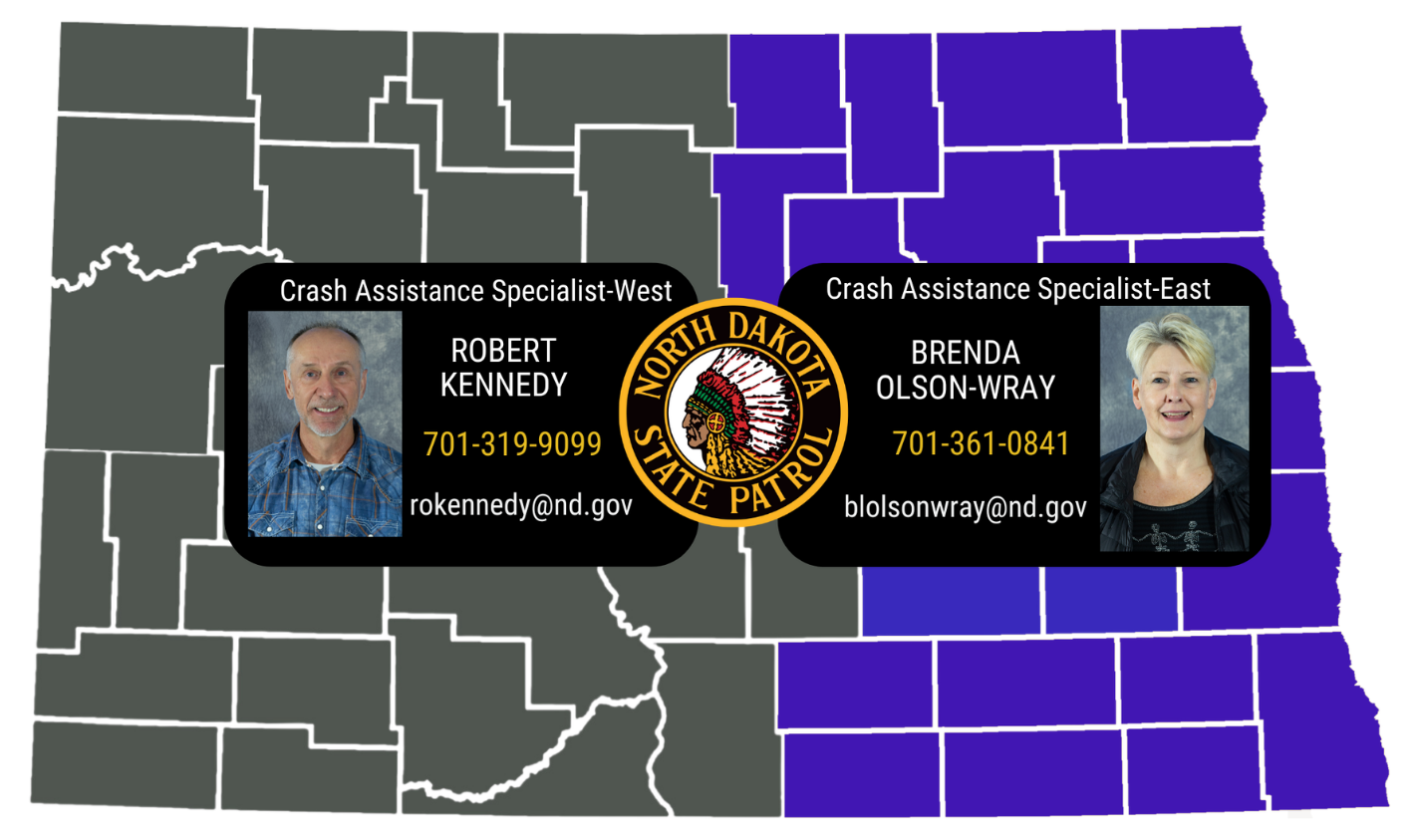
Crash Assistance Program Specialists:
- Western North Dakota: Robert Kennedy
- Eastern North Dakota: Brenda Olson-Wray
Chaplain Program
.png)
Members of the NDHP Chaplain Program provide a trusted individual to NDHP personnel and their families as well as support for individuals upon notification of a family member being involved in a crash.
Chaplains are located throughout the state. Local chaplains are responsible to regional commanders and the Senior Chaplain, currently Pastor Les Wolfgram, Bismarck.
NDHP chaplains are available at the request of members of the department to minister to them or their families in times of illness, injury, grief, or anxiety. Chaplains are also available to assist with message deliveries, such as death notifications, and when called upon in emergency crisis situations.
Cultural Liaison Officer Program
.png)
The North Dakota Highway Patrol created the Cultural Liaison Program in 2017 to enhance culturally diverse relationships through familiar, consistent staff and resources with a goal to build relationships and create a single contact point for questions, comments, or concerns.
The Cultural Liaison Officers (CLO)are sworn peace officers who serves the diverse population of North Dakota. The goals of the CLO program are to build relationships, secure trust, and develop empathy to allow for effective, meaningful dialogue among diverse communities in order to build lasting relationships; foster trust; address community concerns; and provide direct support to patrol operations.
The CLO works within diverse communities including North Dakota's five tribal nations: Sisseton Wahpeton Oyate, Spirit Lake Tribe, Standing Rock Sioux Tribe, Three Affiliated Tribes (MHA Nation), and the Turtle Mountain Band of Chippewa Indians. Each tribal nation is unique with its own beliefs, traditions, protocols, history, and languages.
Contact the NDHP Cultural Liaison Officer, Trooper Shane Rothenberger
The CLO also works with the growing number of New Americans coming to North Dakota that include refugees, immigrants, and asylees. The CLO provides a forum for answering questions and offering safety talks in topics such as winter driving, traffic laws, and interaction with law enforcement. The NDHP Cultural Liaison Program recognizes the LGBTQ+ community in North Dakota and is working to build relationships through community outreach and proactive training for law enforcement.
The work of the CLO is primarily “call-generated”, focusing on immediate needs and concerns. These calls range from missing persons cases, jurisdictional complexities, requests for cross-agency collaboration, cultural awareness training, and youth engagement. The CLO provides information and relational assessment to NDHP leadership as needed and is integral in working with tribal leadership to enhance law enforcement services across the state.
One of the primary duties of the CLO is to provide cultural awareness and diversity training to new police officers at the North Dakota Law Enforcement Training Academy. This training and other resources are available, by request, to other agencies and departments across the state. In addition, the CLO participates in recruiting diverse candidates to ensure NDHP properly represents the citizens of North Dakota.
Mutual Aid Agreements
On June 14, 2022, Governor Doug Burgum, Tribal Chairman Douglas Yankton and NDHP Superintendent Brandon Solberg signed a mutual aid agreement between the Spirit Lake Tribe and the North Dakota Highway Patrol. This agreement will enhance law enforcement in the areas of emergency calls, requests for mutual aid and other law enforcement functions on the Spirit Lake Reservation.
On October 29, 2025 the MOU was re-signed under new leadership, ND Governor Kelly Armstrong and Spirit Lake Tribal Chairwoman Lonna Street-Jackson. The MOU term is until the end of 2027 and will be eligible for renewal January 2028. Read the MOU.
On October 4, 2021, a mutual aid agreement was signed between the Mandan, Hidatsa and Arikara Nation (MHA Nation) and the North Dakota Highway Patrol. This agreement will enhance law enforcement in the areas of emergency calls, requests for mutual aid and other law enforcement functions on the Fort Berthold Reservation. Read the MOU.
Drug Recognition Expert/Standardized Field Sobriety Test Program
.png)
The North Dakota Highway Patrol currently has 10 Drug Recognition Experts (DRE) and eleven Standardized Field Sobriety Testing (SFST) Instructors to enhance impaired driving enforcement efforts and keep North Dakota roadways safe.
The SFST is a battery of three reliable tests performed during a traffic stop to determine if a driver is impaired. The three tests have been scientifically validated and are designed to be simple and easily performed by the average person when not impaired. The tests simulate the divided attention qualities of driving and exercise the same mental and physical attributes that a person needs to drive safely. These tests, like driving, require information processing, judgment, memory, balance, steady reactions, and coordination of limbs.
Trooper Tarek Chase is the North Dakota DRE/Standardized Field Sobriety Testing State Coordinator. Trooper Chase serves as a reference and guide for all DREs, DRE Instructors, and SFST Instructors from each agency in the state and provides reference material, training, and overall guidance to the programs. He also serves as a liaison between local law enforcement agencies and the North Dakota Department of Transportation, the National Highway Traffic Safety Administration, and the International Association of Chief’s of Police for funding and training materials. Contact Trooper Chase, 701-328-2447.
Emergency Response Team
.png)
The North Dakota Highway Patrol Emergency Response Team (ERT) is comprised of officers specially trained for certain emergency situations to include:
- Search and rescue
- Riot/crowd control
- Hostage/barricaded individual situations
- Dignitary protection and security
- Natural disasters such as:
- Tornadoes
- Floods
- Storms
- Hazardous material displacement
- Bomb threats
- Assistance with disturbances at the ND State Penitentiary or any other state institution
K9 Program
.png)
The North Dakota Highway Patrol’s K9 program benefits not only the NDHP, but numerous other agencies in North Dakota. Since the program began in 1994, it has evolved from one dual purpose K9 team to six narcotic detector teams and three man-trailing teams.
The narcotic detectors are primarily Belgian Malinois or German Shepherds and the man trailing canines are Bloodhounds. Each canine is paired with a designated handler and all train and work in their respective specialty.
NDHP K9s live with their handler and quickly become a part of the handler’s family when not working. These dogs are all high drive, high energy, and are ready to go to work every day.
These teams are stationed at various locations in the state and are ready to respond whenever called.
Narcotic Detector Teams complete approximately eight weeks of training and upon certification work to seek out drug couriers, assist local law enforcement agencies, search for illegal substances in schools, and help educate others about the danger of drug use.
Man-trailing canines begin their learning at a young age and naturally progress to trailing/tracking. Upon certification, man trailing teams assist local law enforcement agencies as well as local search and rescue teams. They respond to calls for lost or missing persons and also search for fleeing suspects or suspects who have left the scene of a crime.
Crash Reconstruction Team
.png)
The North Dakota Highway Patrol Crash Reconstruction Team (CRT) applies the science of reconstruction and causation analysis to major crash and crime scenes across the state. The CRT is currently staffed by 16 specially-trained investigators located throughout the state.
CRT personnel are recognized leaders in the field of crash reconstruction who use current technology to document crash and crime scenes. Software is used to generate scale diagrams and to perform mathematical calculations. CRT member's work has proven valuable in criminal prosecutions.
CRT personnel receive extensive training in crash and crime scene reconstruction and keep current in analytical techniques, methodology, and theory. CRT members provide crash investigation training to county and local officers at the North Dakota Law Enforcement Training Academy.
Crash Reconstruction:
- Forensic mapping of crash scenes using total station technology
- Event data recorder downloads and analysis from vehicles
- Recognition and preservation of critical evidence
- Comprehensive analysis of crashes evaluating human, vehicle, and environmental factors
- Professional reports and expert court testimony
Crime Scene Reconstruction:
- Forensic mapping of crime scenes using total station technology
- Trajectory analysis and measurement-related needs
- Computer generated scale diagramming and 3D modeling
- Professional quality trial exhibits
The NDHP CRT provides assistance to local, county, state, and federal law enforcement agencies, and to local and state prosecutors.
Request assistance through regional NDHP supervisors or for additional information, contact CRT coordinator, Trooper Travis Nelson, 701-328-2447.